
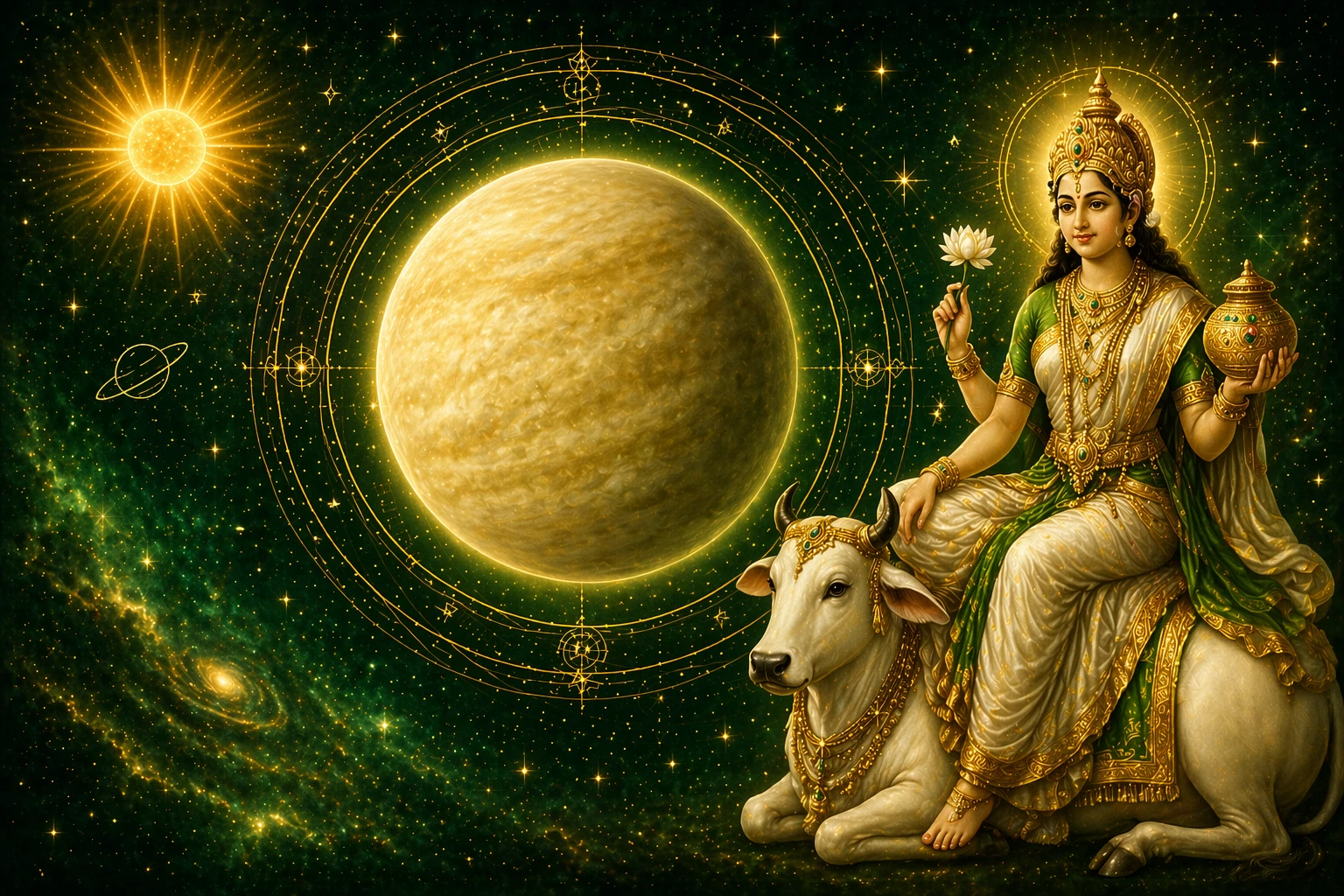



Venus in Vedic AstrologyShukra's Influence on Love and Prosperity
Shukra blesses our love, beauty, and harmony. He teaches art and brings refinement.

Sacred Mantras

- Bathe and wear clean clothes in white or pink.
- Sit facing southeast on a clean mat with the spine straight.
- Hold a White Sphatik mala of 108 beads in the right hand using thumb and middle finger.
- Chant the Beej mantra 108 times per round with steady rhythm.
- Sit quietly afterwards and offer the merit to Shukra with gratitude.

Shukra in Our Life
Benefits of Shukra Mantra
Strengthens love and marital harmony
Enhances charisma and personal magnetism
Brings success in arts, music, and creative fields
Attracts comfort, luxury, and refined living
Supports reproductive and hormonal health
Cultivates aesthetic sensibility and refined taste
Improves diplomatic and negotiation skills
How to Connect with Shukra
Invite the gentle, beauty-loving energy of Shukra into daily life through these classical practices.
Chant Shukra mantra on Fridays.
Offer white flowers, sweet rice, and curd.
Donate white cloth, sugar, ghee, or perfume.
Wear Diamond (Heera) or White Sapphire in silver.
Learn or appreciate music, dance, or visual arts.
Practice kindness, generosity, and beauty in daily life.
Heera
Affirmation








Who is Shukra in Vedic astrology?
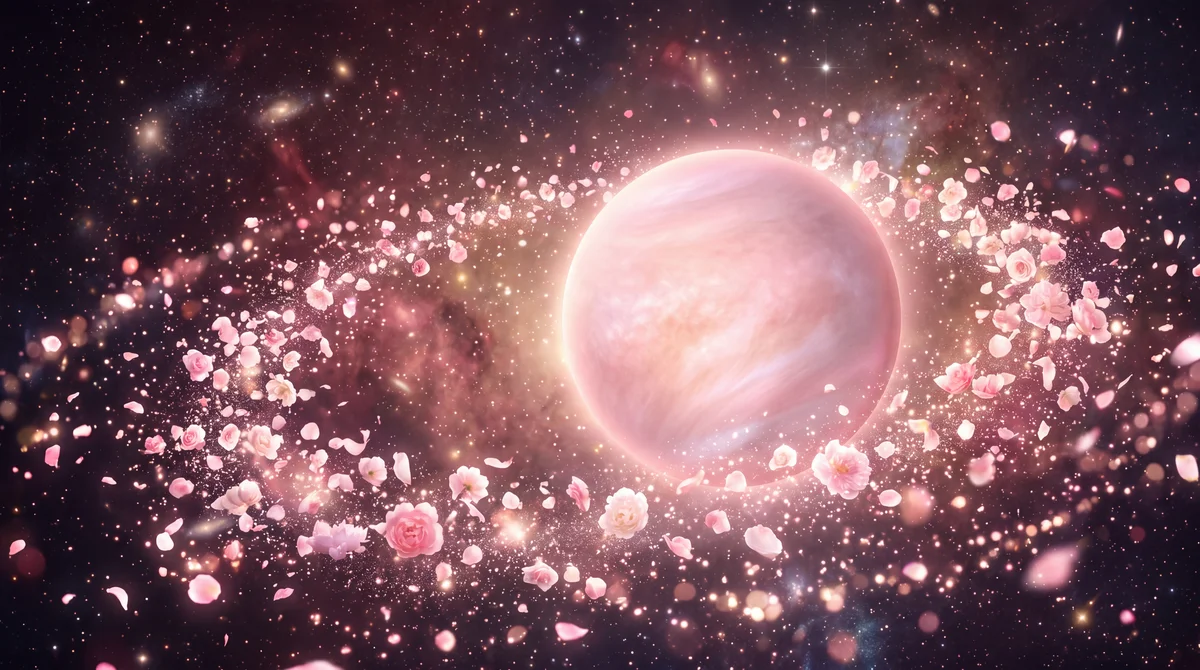
Shukra (Venus) is the most aesthetically significant Navagraha in Vedic astrology, governing love, beauty, relationships, artistic expression, comfort, sensual pleasure, and the harmonious qualities that shape a person's capacity for connection and creative refinement. As one of the inner classical planets, Shukra transits each rashi (zodiac sign) in approximately twenty-five to thirty days, though it goes retrograde once every eighteen months in periods that often ask for relational review. In the Brihat Parashara Hora Shastra, Shukra is described as the preceptor of the asuras, ruler of Vrishabha (Taurus) and Tula (Libra), and the giver of marital harmony, prosperity, and aesthetic sensibility. Venus's placement in the natal chart reveals where a person seeks beauty, expresses love, and finds fulfilment through partnership and creative work. At Soul Infinity Astro Solutions, Saurabh Jain analyses Shukra's house placement, sign dignity, aspects, and current transit position to provide guidance on relationships, marriage timing, and Shukra Mahadasha periods.
He is also called Bhargava (भार्गव), the descendant of the great seer Bhṛgu, and Daityaguru, the teacher of the asuras, the one celestial counsel he could not refuse. As Kavi, the wise poet, he is said to hold the secret of Mṛta-Sañjīvanī, the verse that revives life. Each of these names carries a different shade. As Bhargava he is the inheritor of refined lineage; as Daityaguru he is the teacher who counsels even those the gods will not counsel; as Kavi he is the artist who hears the world as music.
As a karaka, the significator of life themes, Shukra rules marriage, romance, the wife in a man's chart, vehicles, luxury, music, dance, poetry, fashion, hospitality, the reproductive system, and the diplomatic art of harmonious negotiation. When jyotishis read a chart for love, beauty, comfort, or refined creativity, they are tracing the movement of Venus across signs and houses. His blessing is felt as a softening, a sense that life has been made gentler and more beautiful for one's presence in it.
Shukra's Form and Symbolism
Shukra is described in classical iconography with a bright white complexion, the colour of fresh jasmine, snow, and the lotus stem. He is depicted with four arms, holding a rosary (japa-mala), a lotus, a gold staff (daṇḍa), and a water-pot (kamaṇḍalu). He is shown either riding a white horse or seated in a chariot drawn by green or eight horses, depending on the source consulted. [VERIFY: vehicle iconography varies between Skanda Purana and Brihat Samhita.]
His symbolic field is fertility, beauty, water, and the refinement that softens raw form into art. The lotus is his flower because it rises from water with grace; the veena is his instrument because it carries melody as a vessel of feeling; the diamond is his gem because it is clear, hard, and refracts light into rainbows. Silver is his metal because it is cool, shining, and keeps its lustre under the moon. Each correspondence asks the practitioner to look at the world a little more tenderly, to attend to colour, sound, and texture as expressions of the divine.
White flowers, sweet fragrances, music, and the company of women are his favoured offerings. The teaching of the imagery is that beauty is not opposed to spirit but is one of its most direct languages. Where Mars inscribes itself in conviction and Saturn in patience, Shukra inscribes itself in delight, and a chart with a graceful Venus knows how to soften without weakening, and how to enjoy without grasping.
Houses and Signs Shukra Rules
Shukra holds two homes in the zodiac, the fixed earth sign Taurus (Vrishabha) and the cardinal air sign Libra (Tula). Taurus gives him the room to enjoy, to settle into the sensuous textures of life; Libra gives him the room to balance, to find the symmetry between two beautiful things and choose the harmony of both rather than the dominance of one. Taurus is where Shukra savours and Libra is where Shukra negotiates, and a chart with Venus well-placed in either sign tends to carry an unmistakable elegance.
His exaltation is in Pisces (Meena) at twenty-seven degrees according to the Parashari tradition, where Jupiter's expansive devotion lifts Venus into an almost spiritual love. His debilitation is in Virgo (Kanya), the analytical sign of Mercury, where Venus's softness is weighed against detail and can struggle to feel adequate. His mooltrikona, the seat of his most balanced expression, is the first fifteen degrees of Libra. Within these dignities, even small differences in degree can change the tone of love and longing in a chart.
Among the planetary friendships, Shukra counts Mercury (Budh) and Saturn (Shani) as friends; he holds enmity towards the Sun (Surya) and the Moon (Chandra); and Mars (Mangala) and Jupiter (Guru) sit as neutrals. His direction is the south-east, the quarter associated with Agneya, where the gentle warmth of dawn meets the cool moisture of night. These correspondences form the syntax through which a Vedic chart reads the temperament of love and refinement.
Effects of Strong vs Weak Shukra
A strong Shukra in a birth chart is felt as a quiet magnetism. The native carries an air of refinement that does not announce itself, a face that is pleasing without demanding attention, and an instinct for choosing the right word, the right colour, the right gesture. Such a person often does well in fields that ask for grace under elegance: the arts, music, design, fashion, hospitality, diplomacy, perfumery, jewellery, and the careful stewardship of beautiful spaces. The temperament is sweet without being saccharine, and tasteful without being snobbish.
A weak or afflicted Shukra can show up in several quiet ways. Some natives experience persistent relationship struggles, romantic disappointments, or a marriage that arrives late or unsteadily. Others struggle with reproductive concerns, hormonal imbalance, or a tendency to overspend on luxury that does not deliver the contentment it promised. A weak Venus may also produce difficulty appreciating beauty in the everyday, a kind of aesthetic numbness that cannot find pleasure in the small graces. Sometimes the same affliction shows as the opposite, an overindulgence that consumes without satisfying.
It is important to remember that no planet is read in isolation in Vedic astrology. The strength of Shukra depends on his sign, house, the planets that aspect him, his proximity to the Sun (combustion is a particular concern for Venus), the dasha (planetary period) running, and the ascendant. A formally weak Shukra in a benefic chart can still produce magnificent results, while a textbook-strong Shukra under a poorly-timed dasha can struggle. These are general patterns offered for orientation, never personal predictions, and a full chart reading with a qualified jyotishi is the responsible next step.
What is the significance of Venus in the 12 houses?
When Shukra occupies the first house (the lagna), he gives a charming personality, attractive features, a pleasant voice, and a refined sense of self-presentation. In the second house he supports wealth gathered through art or beauty, sweet and persuasive speech, and a family atmosphere of good taste. The third house carries his blessing into artistic siblings, courageous expression in romance, and a creative communication style that wins others without force.
In the fourth house Shukra gives a comfortable home, fine vehicles, maternal blessings, and surroundings that visibly carry the native's aesthetic. The fifth produces love affairs, artistic children, creative intelligence, and a steady gift for romance and the performing arts. The sixth turns Venus's softness into competition through charm, supporting careers in hospitality, diplomacy, and beauty services, with the caveat that debt may accumulate through luxury if discipline is loose.
The seventh house brings a charming spouse, business in beauty or arts, and partnership blessings felt as a quiet daily harmony rather than a dramatic event. An eighth-house Shukra tends towards hidden romances, longevity through pleasure, and an occult thread within artistry that gives the work a sacred undertone. The ninth produces a dharmic spouse, foreign love stories, and a philosophical aesthetic that prefers truth held beautifully to truth held harshly.
The tenth house gives a career in arts, beauty, fashion, luxury, hospitality, or diplomacy, often with public visibility. The eleventh confers gains through women, artistic networks, and refined friendships. The twelfth, the house of liberation, supports foreign romance, hidden luxury, spiritual love, and a deepening of intimacy that is often more inward than outward. [VERIFY: house effects of Venus vary across Parashari and KP systems.]
What is Shukra Mahadasha and what does it bring?
In the Vimshottari dasha system, the Mahadasha of Shukra lasts twenty years, the longest among the planets. When this period activates, the chart turns its focus towards love, marriage, artistic expression, financial abundance, and the steady refinement of life. Themes that have been ripening, especially around relationship, comfort, and creative work, often come forward to be lived through this twenty-year window. For many natives, the Shukra Mahadasha overlaps with their most visible chapters of marriage, family, and material settling.
A favourable Shukra dasha is often experienced as the right marriage at the right time, the birth of children, gains through vehicles or real estate, artistic recognition, and a financial comfort that is felt without ostentation. Long-postponed creative projects find their audience, partnerships deepen rather than strain, and the home itself becomes more beautiful as the years move. The classical literature speaks of a long period of dignified pleasure that supports both inner contentment and outer grace.
A challenging Shukra dasha, particularly when Shukra is afflicted in the chart, can present as relationship conflict, reproductive concerns, excess indulgence, or financial imbalance through luxury. Antardasha sub-periods within the Mahadasha further refine the result; for example, Shukra within Mercury can sharpen artistic communication, while Shukra within Saturn can ask for restraint in pleasure. These tendencies are read alongside the natal chart, transits, and the ascendant lord, and a serious dasha analysis benefits from the eye of a trained astrologer who can weigh dignity, combustion, and aspect together.
What are the remedies for a weak Venus?
Friday (Shukravara) is the day held sacred to Venus, and many traditional remedies begin there. A simple Friday observance includes wearing a touch of white, a light fast, the offering of sweet rice (kheer), curd, sugar, or perfume at a Lakshmi or Saraswati temple, and a few minutes of mantra recitation in a quiet hour. The aim is not appeasement of a difficult planet but a respectful turning of the inner attention towards the qualities Shukra governs, love, beauty, harmony, and the cultivation of refined taste.
Mantra recitation forms the spine of formal Shukra remedies. The Navagraha Shukra stotra and the Beej mantra are shown in the Sacred Mantras section above, and they remain the most widely chanted invocations across the South Asian traditions. Mantras dedicated to Lakshmi, Saraswati, and Durga are popular adjacent practices, since the great feminine principle in Vedic philosophy is closely held with Venus. As with all japa, sincerity is weighted more heavily than haste or volume, and a small daily count practised faithfully usually outlasts an ambitious vow undertaken in restlessness.
Charitable giving on Fridays is classical and effective, particularly the donation of white sweets, sugar, ghee, perfume, silver items, or the sponsoring of a wedding. Diamond (Heera) is the gemstone of Venus, traditionally set in silver, white gold, or platinum on the ring finger of the right hand and installed on a Friday morning after chart verification by a qualified jyotishi. White Sapphire (Safed Pukhraj) and Opal serve as more affordable alternatives with similar tonal effects. A Shukra yantra in silver, kept on a clean altar, supports the same intention. Lifestyle remedies include cultivating beauty in one's surroundings, learning an art or musical practice, honouring women, and tending to cleanliness and grace in everyday speech. None of these remedies replace medical, legal, or financial counsel, and the responsible practice is always remedy alongside, not remedy instead of, qualified human advice.
Astrological Wisdom: Beauty as Devotion
The deepest teaching of Shukra is that beauty, when refined, is a form of devotion. Information about love can be accumulated quickly; the lived practice of love asks for the slow work of attention, gentleness, and the willingness to be moved by another person's interior life. The classical sages observed that natures inclined to beauty become true artists when they learn to let the beauty serve something larger than themselves, while those who do not become collectors of pleasing things who never quite arrive at peace.
Marriage and partnership in the Vedic vision are sadhana, a daily spiritual practice, not a transaction or a status. The vow of two people held together with affection and integrity is itself a teaching about how the soul moves towards the divine. Beauty is therefore not vanity but a doorway, a visible sign of an invisible grace; the lotus that grows from mud is a Venus image, because it says that the world is exactly the right place for the soul to learn to love.
For a modern reader, the practical translation is cultivating taste without snobbery, loving without possessiveness, and creating beauty as service rather than as performance. A well-tended Venus makes a person someone whose presence brings ease into a room, who softens what was hard, who notices what others overlook. Shukra does not promise a life without longing, but he promises a life made gentler by love, and the discernment to recognise true love when it is finally offered.
Quick Facts
Did You Know?
- Shukra is the only celestial teacher of the asuras, the Daityaguru, said to hold the secret of Mṛta Sañjīvanī, the verse that revives life.
- Shukra is exalted in Pisces at twenty-seven degrees, where Jupiter's devotion lifts Venus into spiritual love.
- The Mahadasha of Shukra runs twenty years, the longest of all the planets, often spanning the central chapters of marriage and family.
- Diamond is traditionally installed in silver or platinum on a Friday morning after chart verification.
Friends and Enemies
| Friends | Mercury (Budh), Saturn (Shani) |
|---|---|
| Enemies | Sun (Surya), Moon (Chandra) |
| Neutral | Mars (Mangala), Jupiter (Guru) |
Friendships shape how planets cooperate or compete in the chart.
Embrace the gentle wisdom of Shukra and live with grace, harmony, and refined devotion.
Beauty is the language through which the soul speaks of love.
Common questions about Shukra, Venus strength, mahadasha, gemstone choice, and how Venus energy works in a Vedic chart.
Explore Other Grahas
Continue your journey through the Navagrahas. Each planet shapes a distinct facet of life, mind and karma in the Vedic chart.