
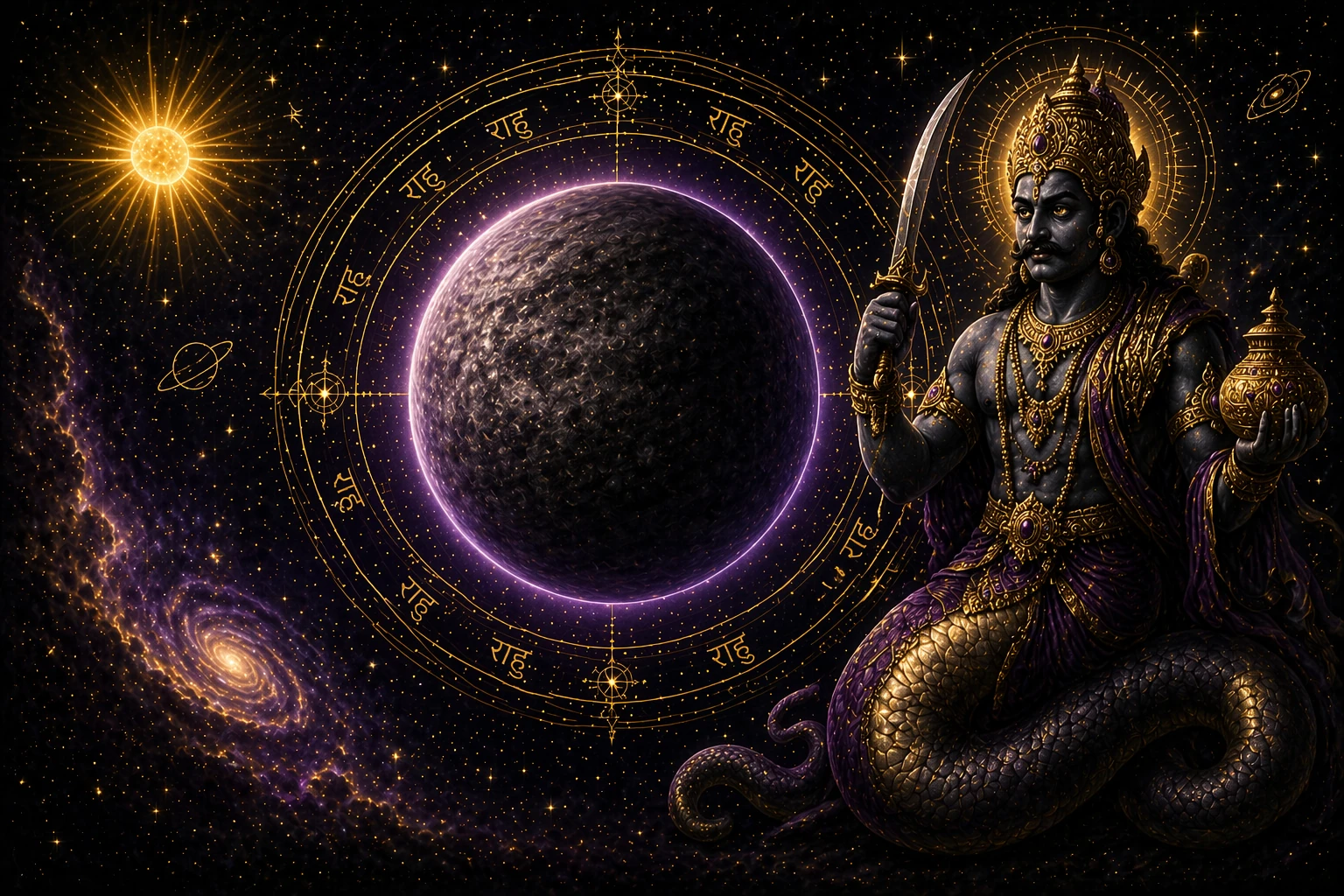



Rahu in Vedic AstrologyEffects, Obsessions and Karmic Lessons
Rahu drives our ambition, illusion
and transformation.
He teaches hunger through amplification.

Sacred Mantras

- Bathe and wear clean clothes in dark blue.
- Sit facing southwest on a clean mat with the spine straight.
- Hold a Hessonite or Sphatik mala of 108 beads in the right hand using thumb and middle finger.
- Chant the Beej mantra 108 times per round with steady rhythm.
- Sit quietly afterwards and offer the merit to Rahu with gratitude.

Rahu in Our Life
Benefits of Rahu Mantra
Drives ambition and worldly success
Opens unconventional career paths
Brings sudden recognition or fame
Strengthens adaptability to change
Supports success in foreign lands or industries
Enhances mastery over technology and modern fields
Cultivates discernment of illusion from truth
How to Connect with Rahu
Chant Rahu mantra on Saturdays.
Offer black sesame, blue flowers, or incense smoke.
Donate to outsiders, the marginalized, or those in distress.
Wear Hessonite (Gomed) only after qualified consultation.
Visit Bhairava temples or perform ancestral tarpan.
Practice meditation to dispel mental fog and obsession.
Gomed
Affirmation


Who is Rahu in Vedic astrology?
Rahu is the karmic shadow planet (Chhaya graha) in Vedic astrology, governing material desire, ambition, foreign influences, sudden change, technology, and the obsessive force that pulls a person toward unconventional paths and unfulfilled karmic patterns from past lifetimes. As a lunar node rather than a physical planet, Rahu moves retrograde through the zodiac, transiting each rashi (zodiac sign) in approximately eighteen months and completing the full cycle in roughly eighteen and a half years. In Vedic mythology, Rahu is the severed head of the asura Svarbhanu and rules no zodiac sign of its own, though it is most powerful in Mithuna (Gemini) and is associated with foreign lands, technology, and intoxication. Rahu's placement in the natal chart reveals where a person experiences strong desire, illusion, and unexpected breakthroughs. At Soul Infinity Astro Solutions, Saurabh Jain analyses Rahu's house placement, sign association, aspects, and Kaal Sarp Dosha indications to provide guidance on Rahu Mahadasha periods.
Classical mythology gives Rahu a face long before it gives him a calculation. During the Samudra Manthan, the great churning of the cosmic ocean, the asura Svarbhanu drank some of the divine nectar (amrita) and was reported to Vishnu by the Sun and Moon. Vishnu severed his head with the sudarshana chakra, but the nectar had already touched his throat, so neither head nor body could die. The head became Rahu and the body became Ketu, the two shadow points that periodically eclipse the Sun and Moon as a long-running revenge.
As a karaka, the significator of life themes, Rahu rules foreign lands, mass communication, cinema, technology, photography, politics, fame, mysteries, snakes, poison, the unconventional, and the obsessive desire that does not know when to stop. He is always retrograde in motion, walking the zodiac backward, which suggests that the fulfilment he points towards is rarely linear and rarely arrives the way the mind first imagines it. [VERIFY: classical karakatva ordering varies between Brihat Parashara Hora Shastra, Phaladeepika, and the various Tantra traditions.]
Rahu's Form and Symbolism
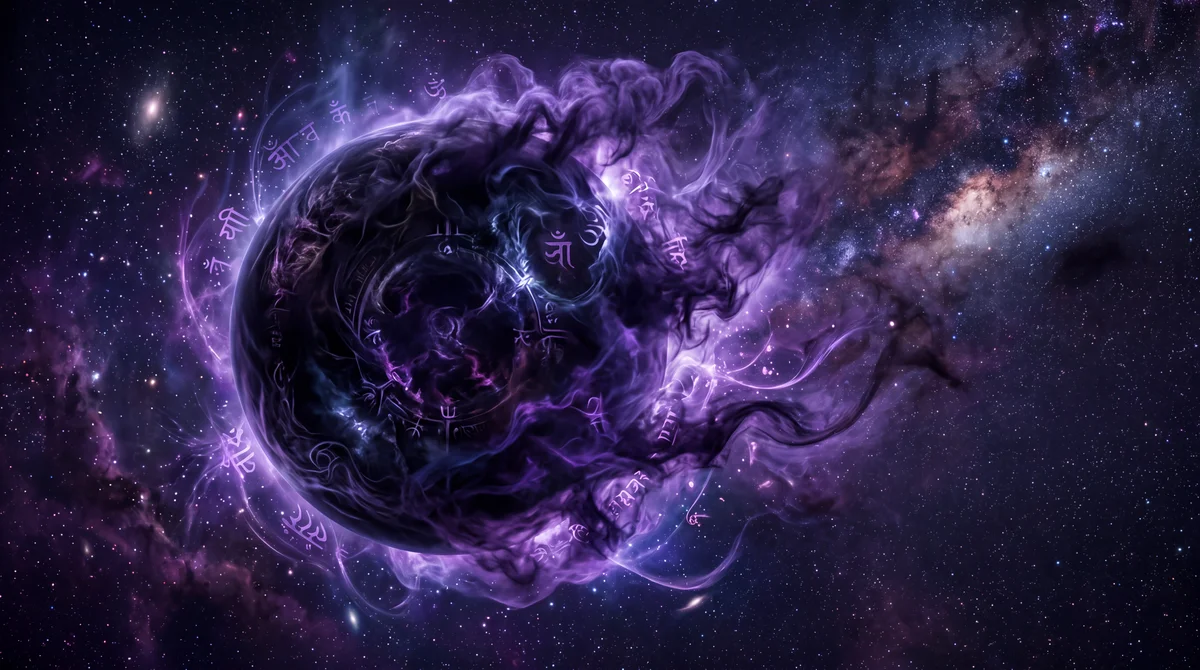
Rahu is described in classical iconography as a half-bodied being, a severed head only, with smoky complexion and intense, hungry eyes. He is depicted with four arms, holding a sword, a trident, a shield, and offering a gesture of warding to the watchful devotee. He is shown either riding a chariot drawn by eight black horses, or seated upon the same chariot as it rolls without driver, since the body that should hold the reins is gone. [VERIFY: iconography varies between Skanda Purana and Brahma Purana.]
His symbolic field is smoke, eclipse, the long shadow, the snake whose presence is felt before it is seen, and the moment in which appearance and reality refuse to match. The snake is his vehicle of meaning because it sheds its skin without hesitation; smoke is his medium because it obscures without entirely hiding; the eclipse is his mythological function because the swallowing of light is, in Vedic terms, the most dramatic visible reminder that the cosmos is not fully tame. Each correspondence asks the practitioner to take seriously what they cannot quite see.
One of the most loved associations of Rahu is his bond with Bhairava, the fierce protective form of Shiva who guards the night and the threshold. Devotional traditions hold that Bhairava worship steadies a difficult Rahu, because the protector of time is older than the seizer of light. Worship of Durga, particularly in her fierce forms, is similarly held to soften Rahu, since the great mother contains within herself the very darkness Rahu inhabits. The teaching is that the shadow is not defeated by avoidance but by recognition.
Houses and Signs Rahu Influences
Rahu has no formal domicile in classical Parashari astrology, since he is not a body but a node. Some lineages assign Aquarius (Kumbha) as an honorary sign because Aquarius is the sign of the unconventional, and others note Virgo as a co-honorary sign owing to Rahu's analytical edge. The sign Rahu sits in is therefore read together with the sign's ruler, who often becomes the dispositor that shapes the actual experience. [VERIFY: domicile assignment for Rahu varies across Parashari, KP, Jaimini, and the Tantra-based lineages.]
His exaltation is in Taurus (Vrishabha) according to most lineages, where Venus's grounded earthiness gives ambition a stable vessel. His debilitation is in Scorpio (Vrischika), where Mars's fierce intensity tends to magnify the shadow in its disruptive form. Some texts reverse these, assigning Gemini and Sagittarius respectively, and the working jyotishi typically tracks results across both conventions before deciding on a chart-by-chart basis. [VERIFY: exaltation and debilitation degrees and signs vary; some lineages place Rahu's exaltation at twenty degrees of Taurus, others at the start of the sign.]
Among the planetary friendships, Rahu typically counts Saturn (Shani), Venus (Shukra), and Mercury (Budh) as friends; he holds enmity towards the Sun (Surya), the Moon (Chandra), and Mars (Mangala); and Jupiter (Guru) sits as a neutral. His direction is the south-west, the quarter of Nairutya, the night-cornered direction associated with ancestors and the unmet karma they leave behind. These correspondences form the syntax through which a Vedic chart reads the temperament of shadow and desire.
Effects of Strong vs Weak Rahu
A strong, well-placed Rahu in a birth chart is felt as a peculiar magnetism. The native carries a charisma that lands across cultural and conventional boundaries, an instinct for spotting opportunity in unconventional places, and the willingness to stand on the edge of a field rather than at its centre. Such a person often does well in fields that ask for ambition without inheritance: foreign service, film, photography, mass media, politics, technology, research into the hidden, and any vocation in which the established middle is too crowded. The temperament is hungry without being merely greedy, and original without being merely contrary.
A weak or afflicted Rahu can show up in several quiet ways. Some natives experience persistent confusion about purpose, obsessive focus that does not return the energy invested, mental fog, anxiety wrapped around the future, or the sense that what was reached for keeps slipping away. Others struggle with addictive tendencies, sudden reversals, or chronic restlessness. The classical literature is consistent on one point: Rahu rarely takes without first dazzling.
It is important to remember that no planet is read in isolation in Vedic astrology, and Rahu in particular is heavily modulated by his house, the nakshatra he occupies, the planets he conjoins, and the sign's dispositor. A formally well-placed Rahu under a difficult dasha can struggle, while a poorly-placed Rahu in a strong chart can produce remarkable, if unconventional, achievement. These are general patterns offered for orientation, never personal predictions, and a full chart reading with a qualified jyotishi is the responsible next step.
Rahu in Each House (1 to 12)
When Rahu occupies the first house (the lagna), he gives an unconventional personality, a face that holds an edge of the foreign or the dramatic, and a temperament that is felt before it is understood. In the second house he amplifies speech, sometimes towards eloquence and sometimes towards exaggeration, can stir family disruption, and creates a complicated relationship with finance. The third house carries his blessing into courage in unconventional fields, a gift for multimedia and short-form expression, and at times a pattern of sibling rivalry that asks for resolution.
In the fourth house Rahu can give foreign settlement, complicated property matters, and a maternal relationship marked by absence or unconventional care. The fifth produces speculation, unconventional creativity, and at times child-related delays or unusual paths to parenthood. The sixth is one of his most loved positions, where he supports victory over enemies, success in service to large institutions, and aptitude for legal or analytical mastery. The seventh brings a foreign or unconventional spouse, intercultural marriage, and partnership shifts that arrive without a long preamble.
An eighth-house Rahu draws the native towards occult mastery, sudden gains and losses, and transformative events that reshape the chart's narrative. The ninth produces a foreign dharma, an unconventional philosophy, and at times a separation, geographical or emotional, from the father. The tenth is another of his strongest houses, often producing sudden career rise, mass-influence careers, and a kind of fame that arrives faster than the native expected.
The eleventh confers gains through unconventional networks and technological income. The twelfth supports foreign settlement, hidden enemies that are sometimes one's own projections, and a spiritual obsession that, when matured, becomes a genuine sadhana. [VERIFY: house effects of Rahu vary widely across Parashari, KP, and Jaimini systems.]
What is Rahu Mahadasha and what does it bring?
In the Vimshottari dasha system, the Mahadasha of Rahu lasts eighteen years. When this period activates, the chart turns its focus towards ambition, foreign opportunity, sudden change, technology, and the kind of mass recognition that arrives from unexpected directions. Themes of identity through achievement, foreign relocation, exposure to different cultures, and the testing of one's relationship with desire often come forward to be lived through the eighteen-year window. Many natives describe a Rahu Mahadasha as the chapter in which they became someone other people now recognise.
A favourable Rahu dasha is often experienced as a rapid career leap, foreign relocation that finally feels like the right next step, fame in modern fields, unexpected gains, mastery in technology, photography, cinema, or politics, and the felt sense that the world has finally caught up with a quality the native already had. The classical literature speaks of an unmistakable elevation that does not always look conventional from the outside but that produces visible change in the native's life trajectory.
A challenging Rahu dasha, particularly when Rahu is afflicted in the chart, can present as obsessive desire that produces only confusion, deceit by partners or colleagues, mental health concerns, sudden losses, and the disorienting sense that the goal one believed in has dissolved on contact. Antardasha sub-periods within the Mahadasha further refine the result, especially Rahu within the dasha of the Sun, Moon, or Mars, which often delivers the most dramatic events. Read alongside transits and the ascendant lord.
What are the remedies for Rahu?
Saturday (shared with Shani) is the day held sacred to Rahu, and many traditional remedies begin there. A simple Saturday observance includes wearing a touch of black or smoky grey, a light fast, the offering of black sesame seeds, blue flowers, mustard oil, or incense smoke at a Bhairava or Durga temple in the late afternoon or evening, and a few minutes of mantra recitation in a quiet hour. The aim is not appeasement of an angry planet but a respectful turning of the inner attention towards the qualities Rahu governs, ambition held with discernment, and desire steadied by self-awareness.
Mantra recitation forms the spine of formal Rahu remedies. The Navagraha Rahu stotra and the Beej mantra are shown in the Sacred Mantras section above, and they remain the most widely chanted invocations across the South Asian traditions. Mantras dedicated to Bhairava, Durga, and the ancestors are popular adjacent practices, since the protector of time and the great mother both contain the very shadow Rahu projects outward. Pitri Tarpan, the offering of water to the ancestors, is a deeply traditional remedy that addresses the karmic line through which Rahu often moves.
Charitable giving on Saturdays is classical and effective, particularly the donation of black sesame, blue cloth, mustard oil, footwear, blankets, and the offering of food or service to outsiders, immigrants, the marginalized, and those without family. Hessonite (Gomed) is the gemstone of Rahu, traditionally set in silver or panchadhatu on the middle finger of the right hand, but only after careful consultation with a qualified jyotishi; Hessonite is highly reactive and amplifies whatever it amplifies, helpful and unhelpful alike. A Rahu yantra in lead or panchadhatu, kept on a clean altar, supports the same intention. Lifestyle remedies include meditation, journaling to track obsessive thought patterns, the practice of discernment in moments of strong desire, and the steady avoidance of shortcuts. None of these remedies replace medical, legal, or financial counsel, and the responsible practice is always remedy alongside, not remedy instead of, qualified human advice.
Astrological Wisdom: Shadow as Mirror
The deepest teaching of Rahu is that the shadow is not the enemy of the light, it is its mirror. Information about ambition can be accumulated quickly; the lived practice of integrating ambition asks for the slow work of noticing what one is actually reaching for, and whether the inner shape of the desire is honest. The classical sages observed that natures inclined to fast achievement become true innovators when they learn to walk with the shadow rather than be driven by it, while those who do not become collectors of trophies who can never explain why they wanted them.
Worldly success without inner clarity becomes a trap. The Rahu placement in a chart often points exactly to the place where the soul has unmet desire from past lifetimes, and reaching that place is therefore not the end of the story but the beginning of a new instruction. The Vedic teaching is that what the shadow holds, the soul has not yet been able to look at directly, and the work of a Rahu period is precisely to look, gently and with steady self-respect, at what was previously turned away from.
For a modern reader, the practical translation is ambition with self-awareness, fame as service rather than ego confirmation, technology as a tool rather than a master, and the willingness to integrate shadow rather than project it onto others. A well-tended Rahu does not erase desire; it clarifies it. The blessing he offers is the discernment to recognise which longing is the soul's own and which is residue finally surfacing for release.
Quick Facts
Did You Know?
- Rahu and Ketu were once a single asura, Svarbhanu, severed by Vishnu's sudarshana chakra after he drank the amrita.
- Rahu is a chhaya graha (shadow planet), a calculated point in the sky rather than a physical body.
- Rahu is always retrograde in motion, walking the zodiac backward.
- Saturday is the day shared between Rahu and Shani, and Bhairava worship is widely held to soften both.
Friends and Enemies
| Friends | Saturn (Shani), Venus (Shukra), Mercury (Budh) |
|---|---|
| Enemies | Sun (Surya), Moon (Chandra), Mars (Mangala) |
| Neutral | Jupiter (Guru) |
Friendships shape how planets cooperate or compete. Rahu's relationships vary across lineages.
Signs of a Strong Rahu
- Magnetism that lands across cultural boundaries
- Instinct for opportunity in unconventional places
- Ambition held with self-awareness
- Mastery in technology, media, or modern fields
- Success in foreign lands or industries
- Charisma that influences groups, not just individuals
- Originality without mere contrarianism
Signs of a Weakened Rahu
- Persistent confusion about purpose
- Obsessive focus that does not return energy
- Mental fog and anxiety wrapped around the future
- Deceit by colleagues or partners
- Sudden reversals in fortune
- Addictive tendencies or chronic restlessness
Rahu rarely takes without first dazzling. Verify with a full chart reading.
Rahu in Houses at a Glance
Read as patterns, never as predictions. Dispositor and nakshatra modulate strongly.
Mahadasha at a Glance
Saturday Practice
- Wear a touch of black or smoky grey
- Light fast and visit a Bhairava or Durga temple
- Offer black sesame, blue flowers, mustard oil, or incense
- Perform Pitri Tarpan for the ancestors
- Donate to outsiders, immigrants, and those without family
- Wear Hessonite ONLY after qualified consultation
- Recite the Beej mantra 108 times in a quiet hour
The shadow teaches what the light cannot reveal.



Embrace the energy of Rahu and transform desire into discernment.
Common questions about Rahu, the shadow planet, mahadasha, gemstone caution, and how Rahu energy works in a Vedic chart.
Explore Other Grahas
Continue your journey through the Navagrahas. Each planet shapes a distinct facet of life, mind and karma in the Vedic chart.