
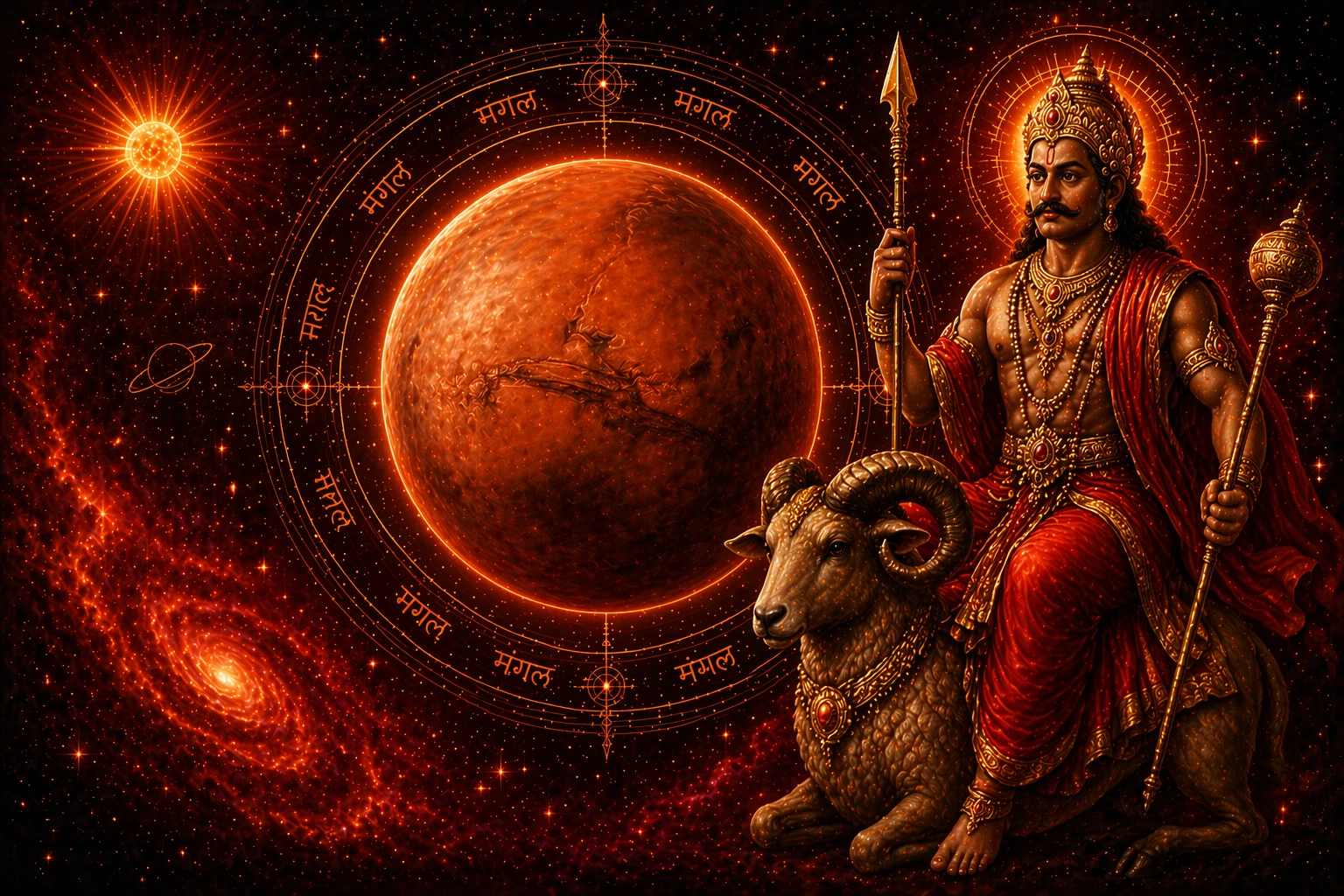



Mars in Vedic AstrologyMangal's Energy, Courage and Effects
Mangala fuels our courage, strength
and determination.
He is the protector who drives us to action and victory.


Sacred Mantras
- Bathe and wear clean clothes in red.
- Sit facing south on a clean mat with the spine straight.
- Hold a Red Coral or red Sphatik mala of 108 beads in the right hand using thumb and middle finger.
- Chant the Beej mantra 108 times per round with steady rhythm.
- Sit quietly afterwards and offer the merit to Mangala with gratitude.

Mangala in Our Life


Benefits of Mangala Mantra
Boosts courage and self-confidence
Enhances physical strength and stamina
Helps in victory over enemies
Brings discipline and determination
Removes fear and laziness
Supports in real estate and land matters
Promotes protection and safety
How to Connect with Mangala
Chant Mangala mantra on Tuesdays.
Offer red lentils, Masoor Dal.
Donate red cloth or jaggery.
Wear Red Coral, Moonga, in copper.
Visit Hanuman temple.
Practice physical exercise and discipline.
Moonga

Affirmation


Who is Mangala in Vedic astrology?
Mangala (Mars) is the most energetic Navagraha in Vedic astrology, governing courage, physical strength, drive, ambition, conflict, and the assertive force that propels a person to act on their convictions and defend their boundaries. As one of the inner classical planets, Mars transits each rashi (zodiac sign) in approximately forty-five days under normal motion, with retrograde periods that ask for restraint, review, and the patient redirection of energy. In the Brihat Parashara Hora Shastra, Mangala is described as the commander of the planetary army, ruler of Mesha (Aries) and Vrishchika (Scorpio), and the giver of valour, technical skill, and decisive action. Mars's placement in the natal chart reveals where a person feels driven to compete, defend, and achieve through sustained effort. At Soul Infinity Astro Solutions, Saurabh Jain analyses Mangala's house placement, sign dignity, aspects, and Mangal Dosha indications to provide precise guidance on action, energy, and Mangala Mahadasha periods.
As a karaka, the significator of life themes, Mangala rules brothers and younger siblings, landed property, real estate, military and police service, athletic effort, the surgical hand, and the precision required by engineering and skilled manual work. In Vedic astrology he is the planet who supplies the will to begin and the stamina to finish. When jyotishis read a chart for drive, decisiveness, or capacity to defend what one loves, they are tracing the movement of Mars across signs and houses. His blessing is initiative; his lesson is restraint.
The general role of Mars is to drive initiative outward and to protect what is precious from harm. He is the warrior who guards dharma, not the bully who picks the fight. Properly held, his fire becomes loyalty, dependability, and the steady backbone of righteous effort. Held poorly, the same fire turns into friction, accident, and impatient anger. The classical traditions therefore frame his worship not as a pursuit of power, but as the steady cultivation of courage, patience, and right action. [VERIFY: Brihat Parashara Hora Shastra and Phaladeepika order Mangala's primary karakatvas slightly differently.]
Mangala's Form and Symbolism
Mangala is depicted in classical iconography with a youthful red complexion, four arms, and a body that radiates warmth like a fresh flame. He is most often shown riding a ram, the symbol of headlong courage, although some texts describe him riding a chariot drawn by red horses through the southern quarter of the sky. In his hands he holds a shakti (spear), a gada (club), a trishul (trident), or a sword, depending on the source consulted. These weapons are not signs of aggression but emblems of vigilance, the readiness of a guardian who watches without sleep. [VERIFY: chariot iconography varies between Bhavishya Purana and Skanda Purana.]
His symbolic field is fire (agni), blood (rakta), and the unborn vital energy (ojas) that becomes muscular strength when channelled. The triangle is his yantra shape because three lines meeting at a point capture the geometry of focused will. Red is his color because it is the color of life force at its most visible, and copper (tāmra) is his metal because it is hot, conductive, and easy to forge. Each correspondence helps the practitioner remember that Mars is concentration of energy at a single sharp edge.
One of the most loved associations of Mangala is his bond with Hanuman, the divine warrior devotee. Devotees often turn to Hanuman when fiery Mars energy needs to be steadied through humility, devotion, and selfless effort. The teaching is gentle and practical: where raw Mars can be reckless, a Hanuman-grounded Mars becomes faithful service. Worship of one quietly strengthens the other, and many remedy traditions weave them together.
Houses and Signs Mangala Rules
Mangala holds two homes in the zodiac, the cardinal fire sign Aries (Mesha) and the fixed water sign Scorpio (Vrishchika). Aries gives him the room to begin freshly and to act first; Scorpio gives him the depth to hold a vow over time and to investigate the unseen. Aries makes the warrior and Scorpio makes the strategist, and a chart with Mars well-placed in either of these signs often shows clear backbone and undivided drive.
His exaltation is in Capricorn (Makara) at twenty-eight degrees according to the Parashari tradition, where the structure of Saturn gives Mars a disciplined channel for effort. His debilitation is in Cancer (Karka), the watery sign of Chandra, where the warrior's edge softens and the energy can dissipate into mood. His mooltrikona, the seat of his most balanced expression, is the first twelve degrees of Aries. Within these dignities, even small differences in degree change the way the planet behaves.
Among the planetary friendships, Mangala counts the Sun (Surya), the Moon (Chandra), and Jupiter (Guru) as friends; he holds enmity towards Mercury (Budh); and he treats Venus (Shukra) and Saturn (Shani) as neutrals. His direction is the south, the quarter of the sky associated with effort, dharma, and the protective gaze of fire. These are not arbitrary correspondences. They form the syntax through which a Vedic chart reads the temperament of action.
Effects of Strong vs Weak Mangala
A strong Mangala in a birth chart is felt as quiet courage rather than loud aggression. The native carries the kind of stamina that returns to a task after rest, the steadiness to take the first step in a difficult conversation, and the confidence to stand alone when the situation requires it. Such a person often does well in competitive fields, military or police service, surgery, athletics, and the careful management of land and property. The temperament is action-oriented but not chaotic; effort is shaped by discipline.
A weak or afflicted Mangala can show up in several forms. Some natives experience flares of anger that do not match the situation. Others struggle with accidents, cuts, burns, or blood-related health concerns that recur until handled at the root. Conflicts with siblings, particularly younger brothers, are also a common pattern, as is restlessness without direction, the body forever ready to move but the mind without a worthy task. The fire wishes to act and finds no honourable outlet, so it turns inward and irritates the system.
It is important to remember that no planet is read in isolation in Vedic astrology. The strength of Mangala depends on his sign, house, the planets that aspect him, the dasha (planetary period) running, and the ascendant. A formally weak Mars in a benefic chart can still produce magnificent results, while a textbook-strong Mars under a poorly-timed dasha can struggle. These are general patterns offered for orientation, never personal predictions, and a full chart reading with a qualified jyotishi is the responsible next step.
Mangala in Each House (1 to 12)
When Mangala occupies the first house (the lagna), he gives a warrior personality, athletic build, and often visible scars or marks acquired in childhood or adolescence. In the second house he produces forceful and direct speech, can stir family conflict, and creates volatility around early-life finances. The third house is his own territory; here he gives the gift of brave communication, strong relations with siblings, and a courage that reaches every conversation.
In the fourth house Mars supports gains through real estate and land, but home life can carry friction unless the energy is consciously cooled. The fifth house produces passionate creativity, sports talent, and a direct relationship with one's own children, sometimes accompanied by concern over their health. In the sixth house Mars is famously well placed, granting victory over opponents, the ability to clear debts, and aptitude for surgical or martial professions. The seventh house brings a dominant partner, the possibility of marriage delays, and the classical concerns of Manglik dosha that should always be weighed against the whole chart.
An eighth-house Mars draws the native towards the occult, deep transformation, and longevity matters, with sudden gains and sudden losses both possible. The ninth produces a dharmic warrior who defends teachers and tradition, often through foreign travel. The tenth gives careers in defense, engineering, surgery, and visible leadership. The eleventh confers gains through siblings and the courage to maintain demanding friendships. The twelfth can mark hidden enemies, a tendency towards foreign settlement, or stays in hospitals, monasteries, and other places of retreat. [VERIFY: Manglik dosha effects and exemptions vary across Parashari, Jaimini, and KP systems.]
What is Mangala Mahadasha and what does it bring?
In the Vimshottari dasha system, the Mahadasha of Mangala lasts seven years. When this period activates, the chart turns its focus towards action, conflict, achievement, and the testing of courage. Themes that have been quietly accumulating, especially around property, siblings, and the body, often come forward to be addressed during this seven-year window. The native is asked to act, and how that action is undertaken shapes the rest of the cycle.
A favourable Mangala dasha is often experienced as career promotion through visible courage, gains through real estate, victory in disputes that have lingered, and a peak in physical strength. Some natives undertake major construction, others enter leadership roles in defense or sport, and many find that long-postponed projects finally complete themselves. The classical literature speaks of a kind of fearless competence that becomes the defining quality of the seven years.
A challenging Mangala dasha can present as accidents, surgeries that should not be deferred, blood-related health concerns, family conflicts, or legal troubles that demand patience. Antardasha sub-periods within the Mahadasha further refine the result; for example, Mars within Mercury can sharpen technical capacity, while Mars within Saturn can slow effort down to the pace of endurance. Even within a generally smooth Mahadasha, a single demanding antardasha can colour an entire year, which is why responsible jyotishis examine both the natal placement of Mars and the sub-period lord together. These are tendencies to be read in conjunction with the natal chart, transits, and the ascendant lord, and a serious dasha analysis benefits from the eye of a trained astrologer.
What are the remedies for Mangal Dosha?
Tuesday (Mangalavara) is the day held sacred to Mars, and many traditional remedies begin there. A simple Tuesday observance includes a light fast, a visit to a temple of Mangala or Hanuman, and the offering of red cloth, jaggery, or red lentils (masoor dal) at the sanctum. The aim is not appeasement of an angry planet but a respectful turning of the inner attention towards the qualities Mars governs, courage, discipline, and protective service.
Mantra recitation forms the spine of formal Mangala remedies. The Navagraha Mangala stotra and the Beej mantra are shown in the Sacred Mantras section above, and they remain the most widely chanted invocations across the South Asian traditions. Daily practice of a small number of repetitions, performed in a quiet hour with sincerity, is often considered more beneficial than long counts done in restlessness. The voice itself learns to settle along with the planet.
Worship of Hanuman is among the most loved adjacent practices because Hanuman embodies disciplined fire offered in selfless service. Reading the Hanuman Chalisa on Tuesdays, visiting Hanuman temples, supporting blood donation drives, donating copper utensils, and giving red lentils or jaggery to those in need are all classical paths. Red Coral (Moonga, also called Praval) is the gemstone of Mars, traditionally set in copper on the ring finger of the right hand and installed on a Tuesday morning after chart verification by a qualified jyotishi. A Mangala yantra in copper, kept on a clean altar, supports the same intention. None of these remedies replace medical, legal, or financial counsel, and the responsible practice is always remedy alongside, not remedy instead of, qualified human advice.
Astrological Wisdom: Energy as Will
The deepest teaching of Mangala is the difference between energy and will. Energy without direction destroys; energy that is anchored in conscience and disciplined towards a task becomes the engine of every good outcome. Anger is not the opposite of strength, it is unrefined strength still searching for its rightful work. The classical sages observed that fiery natures who learn this distinction become protectors, while those who do not become a slow harm to themselves and others.
Courage is the foundation of dharma. Without it, the gentlest virtues stay as private wishes. Patience, kindness, generosity, and the keeping of one's word all require backbone, and Mars is the planet that supplies that backbone. The traditions remind the practitioner that the warrior protects, never aggresses without cause, and that the truest sign of strong Mars is calm in the moment when the unprepared would erupt.
For a modern reader, the practical translation is assertiveness without aggression, leadership through example, and action grounded in conscience. A well-tended Mars makes a person someone others can rely on in difficulty, a steady source of support without theatre. Over time, the same fire that once burned hot in haste begins to burn slowly and faithfully, like the lamp in a temple that never goes out. The blessing of Mangala matures with practice, and the practitioner who walks with him long enough often finds that fear has quietly dissolved into devotion, and that devotion has quietly hardened into the calm courage every life eventually requires. Mangala does not promise an easy life, but he promises a life worth fighting for, and the courage to fight for it well.
Quick Facts
Did You Know?
- Mangala is exalted in Capricorn at twenty-eight degrees, where structure gives fire its sharpest edge.
- Aries and Scorpio together hold the warrior and the strategist sides of Mars.
- Red Coral, the gemstone of Mars, is traditionally installed in copper on a Tuesday morning.
- Hanuman worship is the most loved adjacent practice for steadying fiery Mars energy with humility.
Friends and Enemies
| Friends | Sun (Surya), Moon (Chandra), Jupiter (Guru) |
|---|---|
| Enemy | Mercury (Budh) |
| Neutral | Venus (Shukra), Saturn (Shani) |
Friendships shape how planets cooperate or compete in the chart.
Signs of a Strong Mangala
- Quiet courage under pressure
- Physical stamina that returns after rest
- Backbone in difficult conversations
- Decisive leadership without theatre
- Steady relationships with siblings
- Capacity to protect those one loves
- Aptitude for surgery, engineering, athletics
Signs of a Weakened Mangala
- Anger out of proportion to the situation
- Recurring accidents, cuts, or burns
- Conflicts with younger brothers
- Restlessness without clear direction
- Difficulty finishing what one starts
- Blood-related health concerns
Always best to verify with a full chart reading by a qualified jyotishi.
Mangala in Houses at a Glance
Read as patterns, never as predictions.
Mahadasha at a Glance
Tuesday Practice
- Light fast on Tuesdays
- Visit a Hanuman or Mangala temple
- Offer red cloth, jaggery, or masoor dal
- Read the Hanuman Chalisa
- Donate copper utensils or red lentils
- Wear Red Coral after qualified consultation
- Recite the Beej mantra 108 times in a quiet hour
Courage is the fire that turns dreams into reality.





Common questions about Mangala, Mars strength, Manglik dosha, remedies, and how Mars energy works in a Vedic chart.
Explore Other Grahas
Continue your journey through the Navagrahas. Each planet shapes a distinct facet of life, mind and karma in the Vedic chart.