
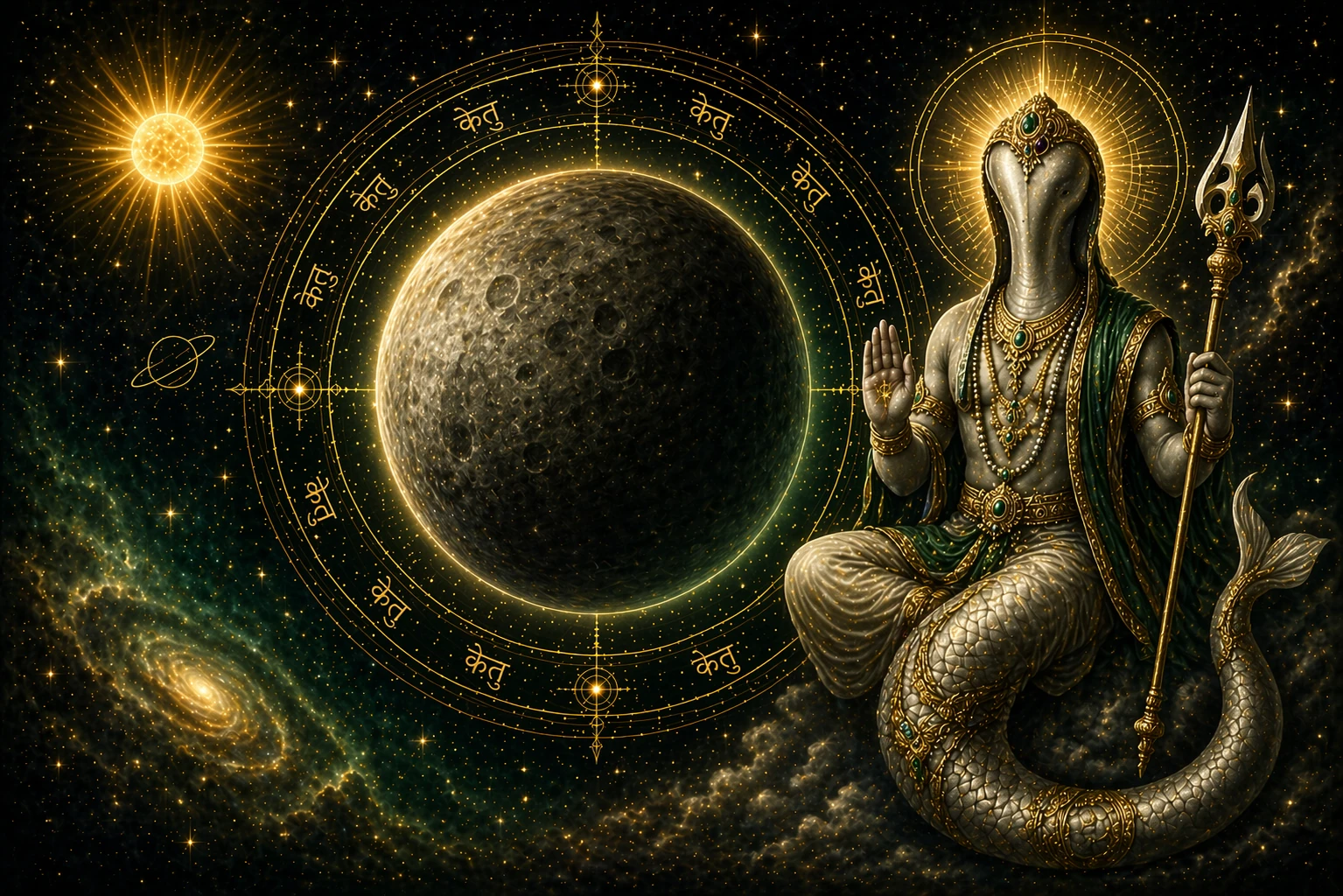



Ketu in Vedic AstrologySpirituality, Detachment and Moksha
Ketu reveals our detachment, moksha
and liberation.
He guides the soul through quiet release.

Sacred Mantras

- Bathe and wear clean clothes in grey.
- Sit facing northwest on a clean mat with the spine straight.
- Hold a Cat's Eye or Sphatik mala of 108 beads in the right hand using thumb and middle finger.
- Chant the Beej mantra 108 times per round with steady rhythm.
- Sit quietly afterwards and offer the merit to Ketu with gratitude.

Ketu in Our Life
Benefits of Ketu Mantra
Awakens spiritual insight and intuition
Cultivates detachment from worldly attachments
Brings sudden moksha-oriented experiences
Strengthens healing, mantra, and meditation practice
Reveals past-life talents and karmic gifts
Supports liberation from old patterns
Sharpens discernment between essence and appearance
How to Connect with Ketu
Chant Ketu mantra on Tuesdays.
Offer multi-grain mixtures, sesame, or smoke incense.
Donate to ascetics, yogis, or those who serve quietly.
Wear Cat's Eye (Lehsunia) only after qualified consultation.
Visit Ganesha or Bhairava temples.
Practice silent meditation, mantra japa, or fasting.
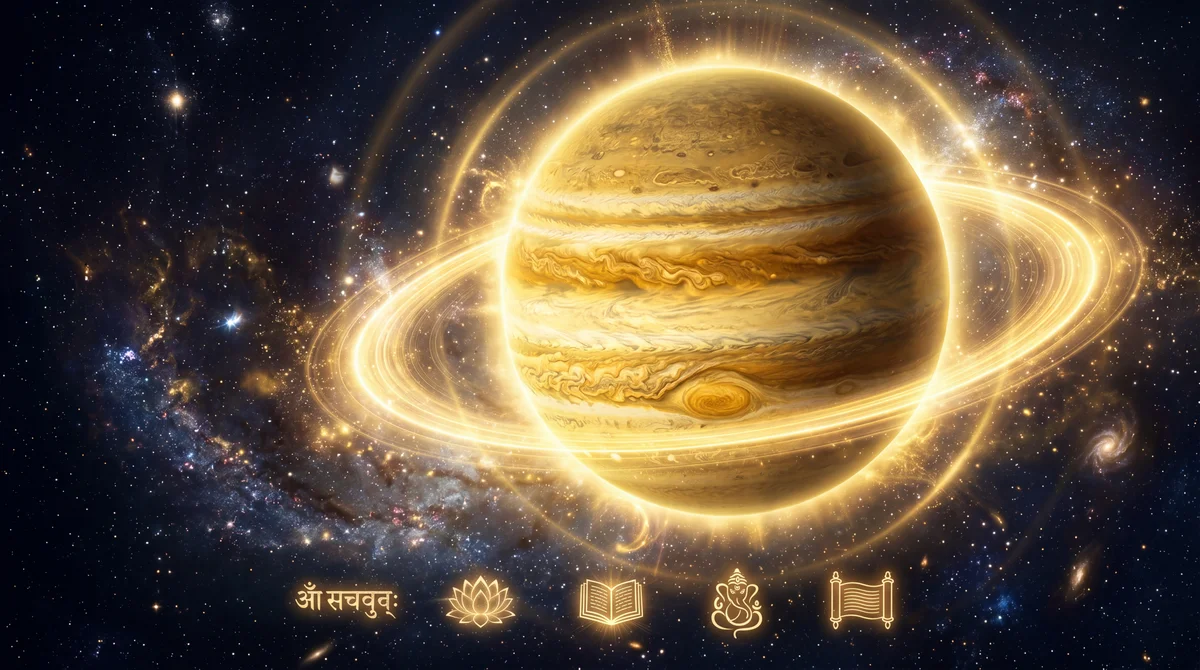
Lehsunia / Vaiduryam
Affirmation







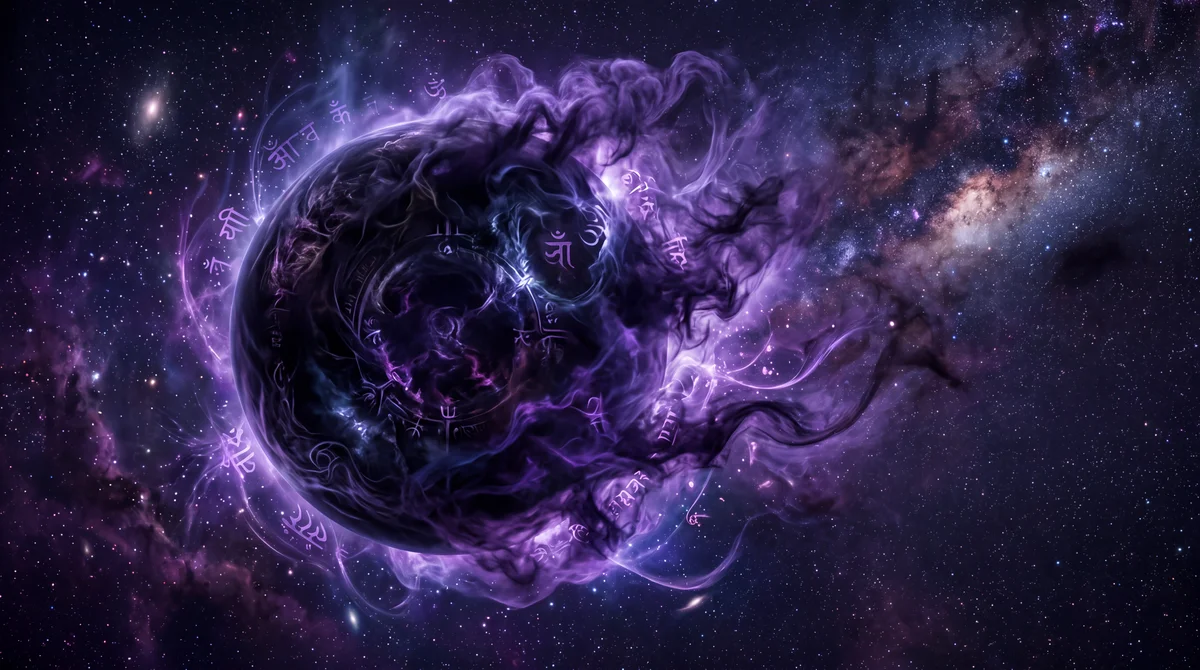

Embrace the wisdom of Ketu and let the soul move forward without burden.
Who is Ketu in Vedic astrology?
Ketu is the spiritual shadow planet (Chhaya graha) in Vedic astrology, governing liberation, detachment, intuition, past life karma, mystical insight, and the dissolving force that draws a person away from material attachment toward inner realisation and moksha. As a lunar node rather than a physical planet, Ketu moves retrograde through the zodiac opposite Rahu, transiting each rashi (zodiac sign) in approximately eighteen months and completing the full cycle in roughly eighteen and a half years. In Vedic mythology, Ketu is the severed body of the asura Svarbhanu and rules no zodiac sign of its own, though it is most powerful in Dhanu (Sagittarius) and is associated with renunciation, occult knowledge, and spiritual practice. Ketu's placement in the natal chart reveals where a person carries inherited mastery, releases attachment, and seeks deeper meaning. At Soul Infinity Astro Solutions, Saurabh Jain analyses Ketu's house placement, sign association, aspects, and current transit to provide guidance on Ketu Mahadasha periods.
The classical mythology pairs Ketu with Rahu in a single story. During the Samudra Manthan, the great churning of the cosmic ocean, the asura Svarbhanu drank some of the divine nectar (amrita) and was discovered. Vishnu severed him with the sudarshana chakra, but the nectar had already touched his throat, so neither head nor body could die. The head became Rahu and the body became Ketu, the two shadow points eternally linked across the chart. Where Rahu hungers outward for what is unmet, Ketu releases inward what has already been mastered.
As a karaka, the significator of life themes, Ketu rules spirituality, healing, mantra, meditation, past lives, hidden knowledge, sudden gains and losses, surgery, astrology, psychic perception, and the sober art of letting go. He is always retrograde in motion, walking the zodiac backward in tandem with Rahu. The teaching is that the soul's freedom often arrives by way of release rather than acquisition. [VERIFY: classical karakatva ordering for Ketu varies between Brihat Parashara Hora Shastra, Phaladeepika, and the various Tantra traditions.]
Ketu's Form and Symbolism
Ketu is described in classical iconography as a headless body holding a flag (the literal meaning of the word ketu), with smoky complexion and an unmistakable air of dissolution. He is depicted with two arms in some accounts and four in others, holding a club, a sword, and the banner from which his name is taken. He is shown either riding a vulture or seated upon a chariot drawn by the same dark bird, the vulture being the creature that completes what death has begun. [VERIFY: vahana iconography varies between Skanda Purana and Brahma Purana.]
His symbolic field is the flag rising from the body of what has been completed, the trail of smoke after the comet has passed, and the stillness that arrives in a room when the talking has finally stopped. The vulture is his vehicle of meaning because it serves where service is hardest; smoke is his medium because it is what is left after fire has done its work; the headless body is his image because the soul that has finished a chapter does not need its old face to recognise itself in the next one.
One of the most loved associations of Ketu is his bond with Ganesha, the remover of obstacles, who is held in some lineages to be his adhi-devata, his presiding deity. Ganesha's image, the elephant-headed body who guards thresholds, is the most accessible doorway to Ketu's wisdom. Worship of Subrahmanya, the warrior-saint son of Shiva, is similarly held to soften Ketu, particularly in matters of dharmic discernment.
Houses and Signs Ketu Influences
Ketu has no formal domicile in classical Parashari astrology, since he is a calculated node rather than a body. Some lineages assign Scorpio (Vrischika) as an honorary sign, the same Mars-ruled sign of depth and transformation, since Ketu's function and Scorpio's temperament share a family resemblance. The sign Ketu sits in is therefore read together with the sign's ruler, who often becomes the dispositor that shapes the actual experience. [VERIFY: domicile assignment for Ketu varies across Parashari, KP, Jaimini, and the Tantra-based lineages.]
His exaltation is in Scorpio according to most lineages, where the depth-ward pull of the sign supports Ketu's release-ward function. His debilitation is in Taurus (Vrishabha), where the steadying earthiness of Venus tends to anchor what Ketu would naturally let dissolve. Some texts reverse these, assigning Sagittarius and Gemini respectively, and the working jyotishi typically watches results across both conventions before deciding on a chart-by-chart basis. [VERIFY: exaltation and debilitation assignments for Ketu vary across classical sources.]
Among the planetary friendships, Ketu typically counts Mars (Mangala) and Jupiter (Guru) as friends; he holds enmity towards the Sun (Surya), the Moon (Chandra), and Mercury (Budh); and Venus (Shukra) and Saturn (Shani) sit as neutrals. His direction is the south-west, the quarter of Nairutya, shared with Rahu, since the two nodes mirror each other across the lunar axis. These correspondences form the syntax through which a Vedic chart reads the temperament of release and inner mastery.
Effects of Strong vs Weak Ketu
A strong, well-placed Ketu in a birth chart is felt as a quiet depth. The native carries an unmistakable spiritual undertone even in conventional settings, an instinct for the inner dimension of any situation, and the willingness to let go of what others would still grip. Such a person often does well in fields that ask for inner authority rather than outer noise: healing, mantra, astrology, surgery, research into the hidden, monastic and contemplative life, and any vocation in which the work's value is not always visible from the outside. The temperament is detached without being cold, and intuitive without being merely mystical.
A weak or afflicted Ketu can show up in several quiet ways. Some natives experience persistent confusion about direction, sudden separations from people or places that previously felt safe, isolation that hardens into loneliness, mental fog, lack of grounding, or unexplained accidents involving fire, surgery, or sharp instruments. Others struggle with a tendency to withdraw at the wrong moment, a kind of premature renunciation that leaves work unfinished. The classical literature is consistent on one point: Ketu rarely takes without first preparing the soul to release.
It is important to remember that no planet is read in isolation in Vedic astrology, and Ketu in particular is heavily modulated by his house, the nakshatra he occupies, the planets he conjoins, and the sign's dispositor. A formally well-placed Ketu under a difficult dasha can struggle, while a poorly-placed Ketu in a strong chart can produce remarkable spiritual maturity. These are general patterns offered for orientation, never personal predictions, and a full chart reading with a qualified jyotishi is the responsible next step.
Ketu in Each House (1 to 12)
When Ketu occupies the first house (the lagna), he gives a detached personality, a spiritual outlook present from a young age, and often distinguishing scars or unique features. In the second house he supports a withdrawn quality of speech, the experience of family separations or distance, and a temperament that holds wealth lightly. The third house carries his blessing into courage in unconventional fields, occult communication, and at times distance between siblings that is nevertheless bridged by understanding.
In the fourth house Ketu can give detachment from one's ancestral home, foreign settlement, and a maternal relationship marked by spiritual influence rather than emotional density. The fifth produces spiritual creativity, the surfacing of past-life talents, and at times child-related delays or unconventional paths to parenthood. The sixth supports victory over enemies through detachment rather than confrontation, success in healing professions, and the steady clearing of old debt through right action.
The seventh house brings a spiritual partnership, possible delays or separations in marriage, and a spouse whose character carries a noticeable interior life. An eighth-house Ketu is one of his strongest positions, supporting occult mastery, longevity, sudden transformations, and a depth of insight that arrives unannounced. The ninth produces a dharmic withdrawal, foreign spiritual lineage, and at times a separation, geographical or emotional, from the father.
The tenth house gives a spiritual or healing-oriented career, leadership through quiet authority, and sudden professional shifts that reorient the life. The eleventh confers detached friendships, spiritual networks, and sudden gains that arrive without long pursuit. The twelfth, the house of liberation, is famously aligned with Ketu's nature, supporting deep meditation, foreign settlement, and the gentle dissolution of attachment into something more spacious. [VERIFY: house effects of Ketu vary widely across Parashari, KP, and Jaimini systems.]
What is Ketu Mahadasha and what does it bring?
In the Vimshottari dasha system, the Mahadasha of Ketu lasts seven years, the shortest among the planetary periods. When this period activates, the chart turns its focus towards spiritual awakening, sudden release, withdrawal from worldly pursuits, and the completion of unfinished karmic threads. Themes of inner work, healing, mantra siddhi, and the quiet release of attachments often come forward to be lived through the seven-year window. Many natives describe a Ketu Mahadasha as the chapter in which something they had been carrying finally fell away.
A favourable Ketu dasha is often experienced as spiritual breakthroughs, mastery in healing or astrology, mantra siddhi, freedom from old burdens, and a clear interior signal that an old chapter has closed cleanly. Long-postponed inner work suddenly becomes possible, contemplative practice deepens, and the native finds themselves quietly more themselves than before. The classical literature speaks of a brief but transformative window in which the soul gathers what it has actually learned and releases the rest.
A challenging Ketu dasha, particularly when Ketu is afflicted in the chart, can present as unexpected losses, sudden separations, mental confusion, accidents involving fire or surgery, or a hospitalisation that arrives without warning. Antardasha sub-periods within the Mahadasha further refine the result; for example, Ketu within Mercury can sharpen analytical detachment, while Ketu within the Sun can ask for a quiet step away from a public role. These tendencies are read alongside transits and the ascendant lord.
What are the remedies for Ketu?
Tuesday (shared with Mangala) is the day held sacred to Ketu, and many traditional remedies begin there. A simple Tuesday observance includes wearing a touch of smoky grey, a light fast, the offering of multi-grain mixtures, sesame seeds, or incense smoke at a Ganesha or Subrahmanya temple, and a few minutes of mantra recitation in a quiet hour. The aim is not appeasement of an angry planet but a respectful turning of the inner attention towards the qualities Ketu governs, detachment, intuition, and the wisdom of letting go.
Mantra recitation forms the spine of formal Ketu remedies. The Navagraha Ketu stotra and the Beej mantra are shown in the Sacred Mantras section above, and they remain the most widely chanted invocations across the South Asian traditions. Mantras dedicated to Ganesha, Subrahmanya, and the ancestors are popular adjacent practices, since Ganesha is held as Ketu's adhi-devata in many lineages. Pitri Tarpan, the offering of water to the ancestors, is a deeply traditional remedy that addresses the karmic threads Ketu often surfaces.
Charitable giving on Tuesdays is classical and effective, particularly the donation of multi-grain mixtures, blankets, footwear, and the offering of food or service to ascetics, yogis, monastic seekers, and those who serve in silence. Cat's Eye (Lehsunia or Vaiduryam) is the gemstone of Ketu, traditionally set in silver or panchadhatu on the middle finger of the right hand, but only after careful consultation with a qualified jyotishi; Cat's Eye is a spiritually potent stone and amplifies whatever it amplifies. A Ketu yantra in iron or panchadhatu, kept on a clean altar, supports the same intention. Lifestyle remedies include silent retreats, simplicity in possessions, regular meditation, and the daily practice of letting go of small outcomes that the mind would otherwise grip. None of these remedies replace medical, legal, or financial counsel, and the responsible practice is always remedy alongside, not remedy instead of, qualified human advice.
Astrological Wisdom: The Light of Letting Go
The deepest teaching of Ketu is that what the soul has already mastered must eventually be released so that something new can arrive. Information about detachment can be accumulated quickly; the lived practice of detachment asks for the slow work of completing chapters consciously, of saying thank-you to a teacher whose work in your life is done, and of trusting that release is not loss. The classical sages observed that natures inclined to depth become true mystics when they learn to walk lightly with what they have known, while those who do not become collectors of identities they no longer fit.
Liberation in the Vedic vision is not abandonment. It is the wisdom of non-attachment, the steady refusal to confuse the self with what the self has carried. Past-life gifts await activation through dharmic surrender, and the work of a Ketu period is often precisely to recognise a talent that the soul brought with it and to put it gently into service rather than into ego.
For a modern reader, the practical translation is minimalism with purpose, completing cycles consciously, intuitive trust, and the willingness to walk away from what was once correct but no longer is. A well-tended Ketu does not produce a cold or absent life; it produces a clear one. The blessing he offers is the discernment to recognise when a chapter has actually closed, and the courage to turn the page without bitterness or backward glance.
Quick Facts
Did You Know?
- Ketu and Rahu were once a single asura, Svarbhanu, severed by Vishnu's sudarshana chakra. Ketu is the body, Rahu the head.
- The word ketu literally means “banner” or “flag”, and also “comet” in classical Sanskrit.
- Ganesha is held to be Ketu's adhi-devata in many lineages, the presiding deity who softens difficult Ketu transits.
- Ketu's seven-year Mahadasha is the shortest among the major planetary periods.
Friends and Enemies
| Friends | Mars (Mangala), Jupiter (Guru) |
|---|---|
| Enemies | Sun (Surya), Moon (Chandra), Mercury (Budh) |
| Neutral | Venus (Shukra), Saturn (Shani) |
Friendships shape how planets cooperate. Ketu's relationships vary across lineages.
Signs of a Strong Ketu
- Quiet spiritual depth even in conventional settings
- Instinct for the inner dimension of any situation
- Mastery in healing, mantra, or astrology
- Detachment without coldness
- Sudden liberation from old burdens
- Past-life talents that surface unannounced
- Discernment between essence and appearance
Signs of a Weakened Ketu
- Persistent confusion about direction
- Sudden separations from people or places
- Isolation that hardens into loneliness
- Mental fog and lack of grounding
- Accidents involving fire, surgery, or sharp tools
- Premature renunciation that leaves work unfinished
Ketu rarely takes without first preparing the soul to release.
Ketu in Houses at a Glance
Read as patterns, never as predictions. Dispositor and nakshatra modulate strongly.
Mahadasha at a Glance
Tuesday Practice
- Wear a touch of smoky grey or silver
- Light fast and visit a Ganesha or Subrahmanya temple
- Offer multi-grain mixtures, sesame, or incense
- Perform Pitri Tarpan for the ancestors
- Donate to ascetics, yogis, and silent servers
- Wear Cat's Eye ONLY after qualified consultation
- Recite the Beej mantra 108 times in a quiet hour
What you release becomes your liberation.
Common questions about Ketu, the shadow planet, mahadasha, gemstone caution, and how Ketu energy works in a Vedic chart.
Explore Other Grahas
Continue your journey through the Navagrahas. Each planet shapes a distinct facet of life, mind and karma in the Vedic chart.