
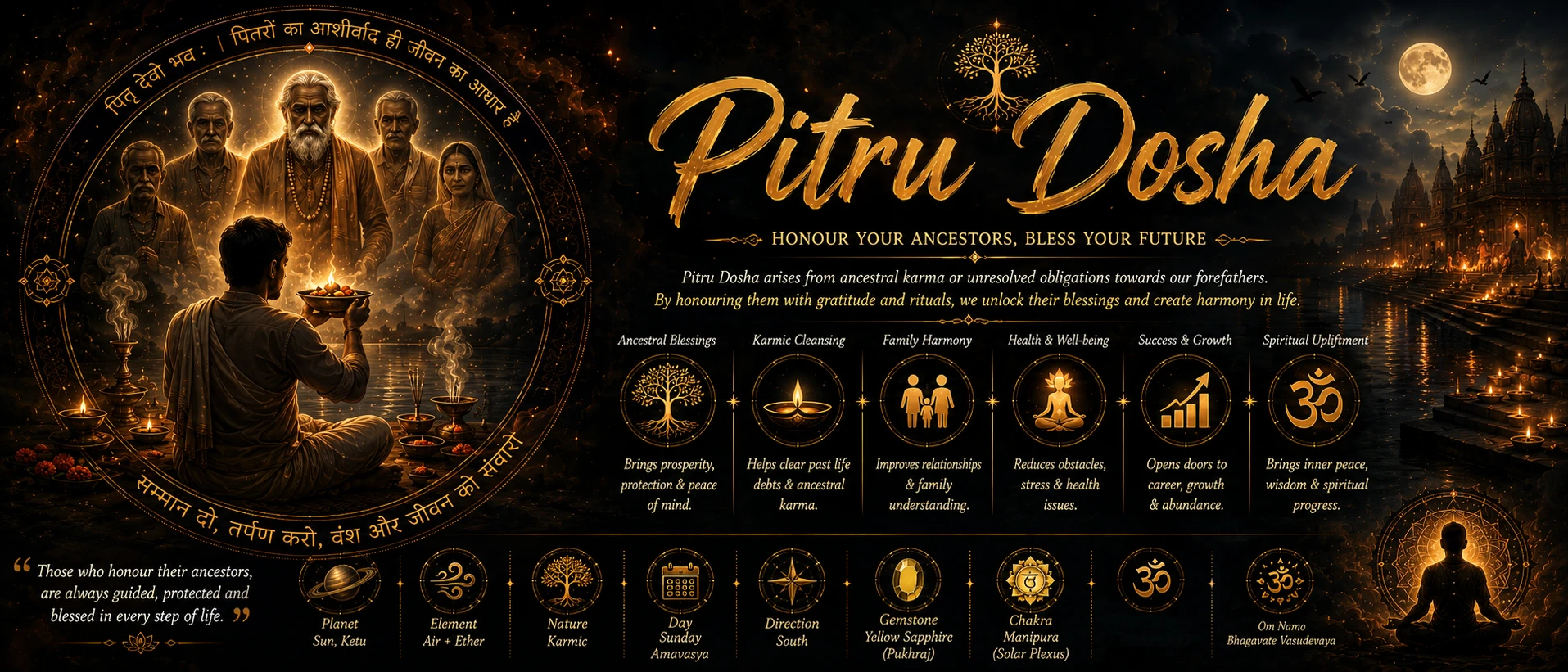
पितृ दोष·Pitru Dosha
Pitru Dosha, The Ancestral Karmic Debt
Ruled by Surya and Shani (Sun and Saturn)·The Father Line Karma·Ancestral Unfulfillment
The Ancestral Imprint
Pitru Dosha refers to a karmic imprint in the birth chart linked to unfulfilled obligations of ancestors, particularly on the paternal line. Classical Vedic texts including the Garuda Purana and Vishnu Purana associate certain planetary configurations with ancestral debt that manifests as recurring patterns across generations.
The Sun-Saturn Axis
The primary planetary indicators are afflictions to the Sun, the significator of the father and ancestors, and Saturn, the planet of karma and time. When these planets are afflicted by Rahu, Ketu, or malefics in the 9th, 5th, or 2nd house, Pitru Dosha may be present.
A Signal for Conscious Action
At Soul Infinity, Saurabh Jain approaches Pitru Dosha not as a helpless curse but as an invitation to consciously fulfill ancestral duties. Shraddha, Tarpan, and ancestral service are practical karmic actions that complete what previous generations could not complete.
Soul Infinity Practitioner Insight
Saurabh Jain, trained at the K.N. Rao Institute of Astrology, New Delhi, observes that Pitru Dosha is emotionally charged because it involves family lineage and ancestral memory. A careful chart reading distinguishes genuine ancestral karma from incidental combinations.
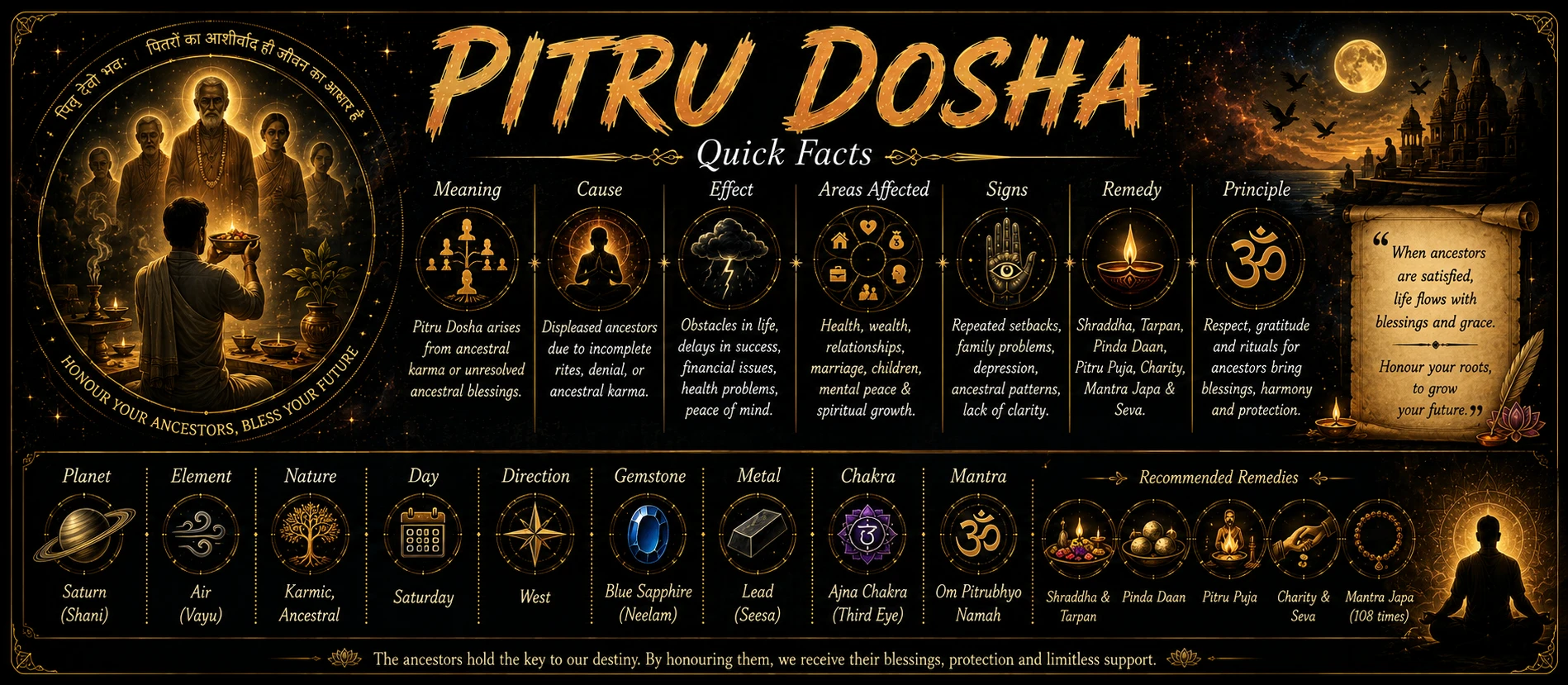
Ruled by Surya and Shani (Sun and Saturn)
The Sun governs the father, authority, the soul, and the paternal ancestral line in Vedic astrology. Saturn governs karma, time, obligations, and the consequences of unfulfilled duties. Together they define the karmic relationship between the native and ancestral heritage.
Power and Potential
Natives with Pitru Dosha who consciously perform ancestral rituals and fulfill paternal duties often experience release of generational patterns. This completion of ancestral karma is considered spiritually meaningful action.
Unaddressed Pitru Dosha is associated with obstacles to progeny, recurring difficulties on the paternal side, unexplained career stagnation despite effort, and a sense of ancestral weight across generations.
Mahadasha Timing
The Sun Mahadasha, 6 years, and Saturn Mahadasha, 19 years, are the periods during which Pitru Dosha most actively manifests. Natal strength and house placement of both planets are essential.
Ancestral House Strip
Living with Pitru Dosha
Ancestral karma can feel heavy, but conscious ritual and duty can turn it into lineage healing.
Strengths When Addressed
Challenges When Unaddressed
Pitru Dosha Indicators Across the Chart
SUN AFFLICTED IN 9TH
Sun in the 9th house afflicted by Rahu, Ketu, or Saturn. The 9th is the primary house of the father and dharma. Affliction here is the strongest indicator.
SATURN IN 9TH HOUSE
Saturn placed in the 9th house, especially with malefic aspects. Saturn in the house of father and dharma can indicate unresolved paternal karma.
RAHU WITH SUN
Rahu conjunct the Sun in any house, particularly the 1st, 5th, or 9th. Rahu eclipses solar energy, creating a shadow over paternal connections.
KETU IN 9TH HOUSE
Ketu in the 9th house indicates past-life karma related to the father line, often involving spiritual obligations or duties left incomplete.
AFFLICTED 5TH HOUSE
The 5th house governs progeny and past-life merit. Malefic or Rahu-Ketu afflictions here are associated with ancestral karma affecting the next generation.
SUN-SATURN CONJUNCTION
Sun and Saturn in conjunction, particularly in the 9th, 5th, or 1st house. The father significator and karma planet together form a classical indicator.
SUN IN ENEMY SIGN
Sun placed in Libra or another enemy sign and additionally afflicted by Rahu or Saturn compounds the ancestral karmic signature.
NO MALE PROGENY PATTERN
Classical texts note recurring patterns of no male progeny across generations, especially when the 5th lord is afflicted and other indicators are present.
AMAVASYA BIRTH
Birth on Amavasya with additional Sun or Saturn afflictions is sometimes cited as a Pitru Dosha indicator in traditional practice.
FATHER-LINE HEALTH PATTERNS
Recurring similar health challenges on the paternal side across generations are considered a functional indicator when corroborated by chart factors.
SATURN ASPECTING SUN
Saturn's 3rd, 7th, or 10th aspect falling on a compromised natal Sun creates a combined father-karma signature.
9TH LORD AFFLICTED
The 9th lord afflicted by malefics or placed in the 6th, 8th, or 12th house weakens the ancestral blessings channel.
Classical Vedic Remedies for Pitru Dosha
Traditional ancestral remedies, applied with sincerity and chart-based judgment
Perform Shraddha and Tarpan during Pitru Paksha
The most important classical remedy, performed on the ancestor's tithi or Sarvapitri Amavasya if the date is unknown
Perform Tarpan on Amavasya every month
Monthly new moon Tarpan is a consistent ancestral offering that keeps the connection active
Feed Brahmins, the poor, and crows on Amavasya
Crows are considered messengers of ancestors in the Vedic tradition
Donate on behalf of ancestors in their name
Food, clothing, and education support for the underprivileged is considered direct ancestral merit transfer
Plant trees, particularly peepal, banyan, or tulsi
Classical texts recommend tree planting as a remedy for ancestral debt
Chant Pitru Gayatri mantra daily during Pitru Paksha
Om Pitru Devaya Vidmahe, Jagat Dharaya Dhimahi, Tanno Pitru Prachodayat invokes ancestral blessings
Perform Narayan Bali or Tripindi Shraddha where prescribed
These elaborate rituals are not recommended without proper chart assessment and pandit guidance
Frequently Asked Questions
Your top questions about Pitru Dosha, answered with ancestral and chart context.
Pitru Dosha refers to an ancestral karmic imprint in the birth chart associated with unfulfilled obligations of the paternal ancestral line. Classical texts identify afflictions to the Sun, Saturn, or 9th house as indicators that ancestral debt requires conscious resolution through ritual and service.
Want a Personalised Pitru Dosha Reading?
Saurabh Jain at Soul Infinity reads Pitru Dosha in your full birth chart context, identifies specific ancestral indicators, and recommends the classical remedies most appropriate for your chart without fear and without unnecessary rituals.
Book a Consultation