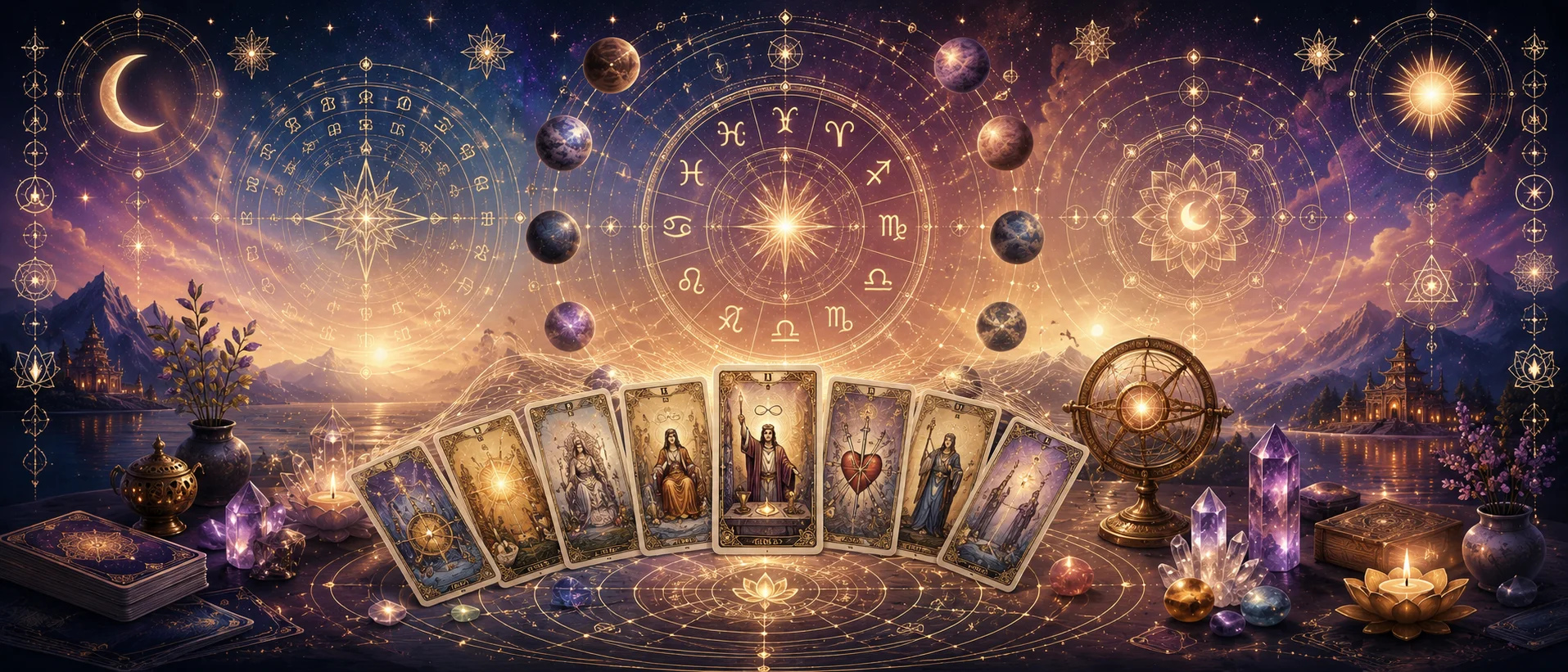
Tarot card reading vedic astrology integration is one of the more interesting developments in contemporary Indian astrological practice. While tarot originated in Europe and traveled through various mystical traditions, its symbolic depth and capacity to provide moment-specific guidance make it complementary to the structural depth of Vedic Jyotish. This guide explains tarot, how it differs from astrology, and how the two can be used together for comprehensive guidance.
What is Tarot?
Tarot is a system of 78 cards (22 Major Arcana plus 56 Minor Arcana) developed in Europe over the past several centuries. The cards carry symbolic archetypes representing fundamental life forces, situations, and patterns. A tarot reading involves shuffling the cards, drawing a specific spread, and interpreting the cards in their drawn positions.
The Major Arcana represents major life forces and themes (The Fool, The Magician, The High Priestess, and so on through The World). The Minor Arcana is divided into four suits (Cups, Pentacles, Swords, Wands) representing emotions, material life, intellect, and action.
Tarot is not predictive in the deterministic sense; it provides a symbolic mirror of the energetic patterns currently active in a situation. A skilled reader uses the cards to surface insights, choices, and consequences that may not be visible to the questioner.
How Tarot Differs from Vedic Astrology
| Aspect | Tarot | Vedic Astrology | |---|---|---| | Foundation | Symbolic archetypes | Planetary positions | | Time scale | Current moment to short-term future | Lifetime structural patterns | | Format | Cards drawn in spreads | Calculated chart from birth data | | Best for | Specific current questions | Long-term timing and patterns | | Birth data needed | No | Yes (date, time, place) | | Mechanism | Symbolic intuition | Mathematical and rule-based | | Tradition | European (with various roots) | Indian classical |
Both are valid traditions with different strengths. Tarot does not need birth data and can be applied to any question immediately. Vedic astrology needs accurate birth data but provides deeper structural insight that tarot cannot.
When to Use Tarot vs Astrology
Use tarot for:
- "Should I take this specific job offer?"
- "How is this relationship developing right now?"
- "What energy is around this decision?"
- "Should I have this difficult conversation?"
- "What am I not seeing about this situation?"
- "How will the next 3 months unfold for this project?"
Use Vedic astrology for:
- "What is my dharma?"
- "When will I marry?"
- "Which career fits my chart?"
- "What is my current Mahadasha and Antardasha bringing?"
- "What does Sade Sati mean for me?"
- "Is this relationship compatible long-term according to our charts?"
- "What is the karmic pattern of my family?"
Both systems answer "what should I do" questions, but they answer at different depths and time scales.
A Combined Tarot and Astrology Consultation
At Soul Infinity, many consultations integrate tarot with Vedic astrology. A typical combined session might:
- Begin with the birth chart context: which dasha is active, which transits are influencing the question, what the structural pattern is
- Move to tarot for the specific moment-question: what energy is around this decision now
- Integrate the two: the astrological structure provides the long-term framework; the tarot provides the immediate guidance
- Conclude with practical recommendations: what to do, when to act, what to be aware of
The integration is more useful than either alone for clients facing specific decisions within larger life questions.
Tarot for Specific Question Types
Career decisions: A 5-card spread covering present situation, what is supporting, what is blocking, the likely outcome, and the wisdom to apply. The Major Arcana cards in this spread often indicate the deeper karmic theme.
Relationships: A 7-card spread covering your energy, partner's energy, the connection, what is supporting, what is challenging, the near-term direction, the wisdom to apply.
Specific decisions: A 3-card spread (past, present, future) or 5-card spread for more nuance.
Spiritual questions: A single card or simple spread focusing on the current guidance available.
The reading is most useful when the question is clear and focused. Vague questions produce vague guidance.
What to Expect in a Tarot Session
Pre-session: You identify the question or area you want to explore. The clearer the question, the more focused the reading.
The reading: The reader (Saurabh Jain) shuffles the deck while focusing on your question, then draws cards in a specific spread. The cards are interpreted in their positions, with attention to the relationships between cards.
Discussion: The reader explains what the cards reveal and helps you integrate the insights with your specific situation.
Action items: The reading concludes with practical guidance: what to do, what to be aware of, what to avoid.
A typical tarot session runs 45 to 60 minutes for a single focused question, or 75 to 90 minutes for multiple questions or combined tarot-astrology work.
The Reader's Role
Tarot accuracy depends significantly on the reader's skill. A skilled tarot reader:
- Has trained extensively in the tarot symbolism and spreads
- Combines intuitive perception with knowledge of the cards
- Focuses fully during the reading without distraction
- Is honest about what the cards show, even when difficult
- Empowers the client rather than creating dependency
- Knows when to refer to other modalities (such as Vedic astrology) for the deeper picture
At Soul Infinity, tarot is practiced as a serious guidance tradition, not as entertainment or fortune-telling.
Common Misconceptions About Tarot
"Tarot predicts the future." Tarot reveals current energetic patterns and likely directions; it does not predict deterministic outcomes. Free will and conscious action change outcomes.
"Some cards are always bad." Cards like Death, Tower, or Devil have intense imagery but their meaning depends on the question and position. The Death card often represents transformation, not literal death. The Tower represents necessary breakdown of false structure.
"You should never read your own cards." Self-reading is possible but more difficult because of the practitioner's emotional involvement. Many tarot readers prefer to work with another reader for their own significant questions.
"Tarot conflicts with Hinduism." Many serious tarot practitioners integrate the tradition with Vedic and Indian spirituality without conflict. The card symbolism is universal enough to translate across traditions.
Booking a Tarot Reading
For a tarot reading at Soul Infinity, with or without integrated Vedic astrology, contact us through WhatsApp. Mention your question or focus area so we can prepare appropriately.