
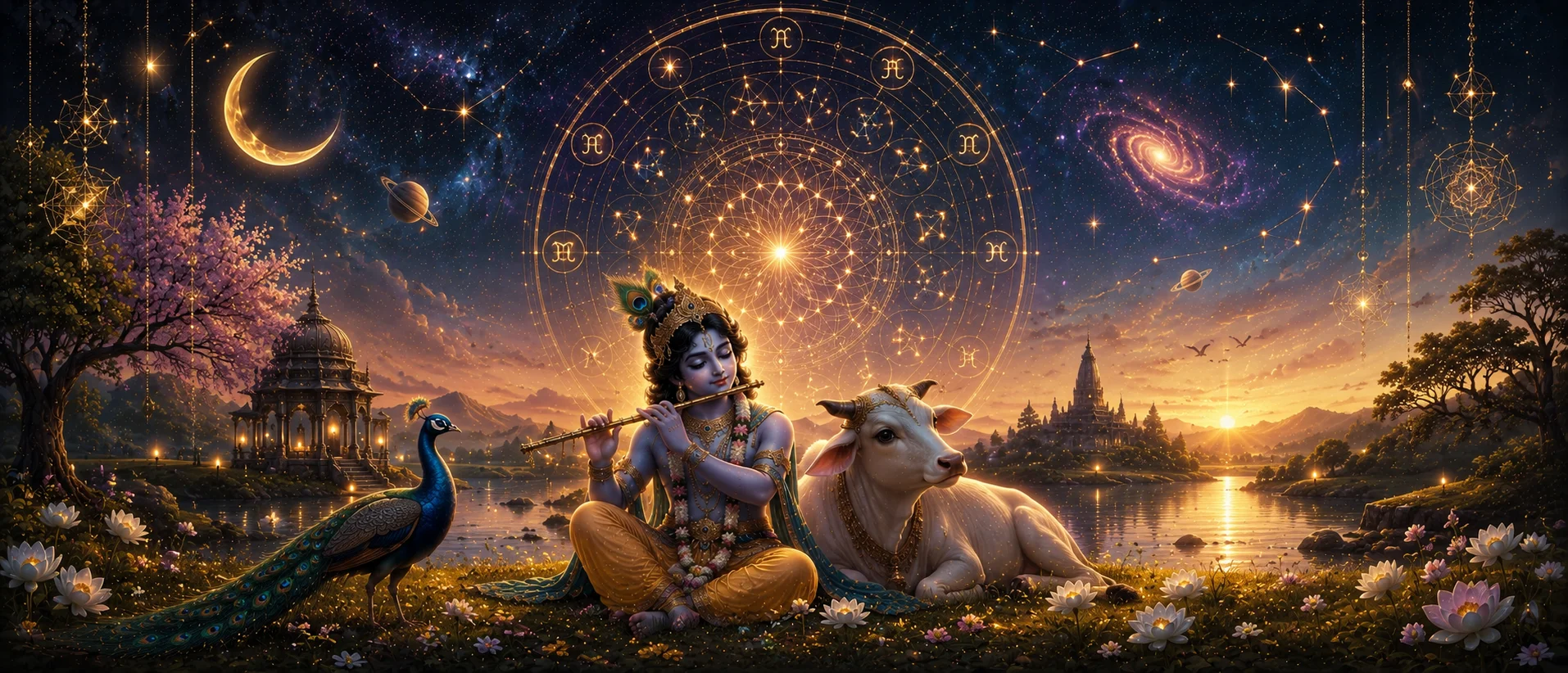
The connection between Lord Krishna and Rohini nakshatra is one of the most beautiful intersections of mythology and astrology in the Vedic tradition. Krishna is said to have been born under Rohini nakshatra, with Moon at Taurus in the Rohini portion. This single astrological fact transforms the way Vaishnava tradition observes Janmashtami: the festival is not just about the lunar day but about the precise alignment of Ashtami tithi with Rohini nakshatra. When these coincide, the resulting Jayanti Yoga is considered the most sacred moment in the lunar calendar.
This guide explains which nakshatra Krishna was born under, the astrological significance of his chart, why Rohini matters at Janmashtami, how Janmashtami 2026 will be calculated, and what it means for any native to share Krishna's nakshatra.
Which Nakshatra Was Krishna Born Under?
Classical Vedic tradition is clear: Lord Krishna was born under Rohini nakshatra. His Moon sign was Vrishabha (Taurus), and his Moon was placed in the Rohini portion of Taurus, which spans 10 to 23 degrees 20 minutes. This is why Krishna is sometimes called Rauhineya (born under Rohini) and why Rohini's daughter, Yashoda, appears in Krishna's story as his foster mother.
The Krishna born rohini nakshatra connection runs deep. Rohini is the Moon's most beloved nakshatra, and Krishna is celebrated as the embodiment of divine love. The mythology of Chandra's exclusive devotion to Rohini parallels the bhakti tradition's exclusive devotion to Krishna. Both stories teach the same lesson: love this deep must learn to be both whole and free.
The Astrological Significance of Krishna's Chart
Vedic tradition reconstructs Krishna's birth chart from the textual indications in the Mahabharata and Bhagavata Purana: born at midnight, Krishna Paksha Ashtami of Bhadrapada month, in Rohini nakshatra, with Vrishabha rashi for the Moon, and various other indications.
The most-discussed chart features include: Moon in Rohini (the auspicious own-nakshatra placement), Mercury and Mars in particular configurations, and the lagna at Vrishabha (Taurus) in some readings or Mithuna (Gemini) in others. The exact lagna is debated, but the Moon in Rohini is consistently affirmed across traditions.
The astrological resonance of this placement is the foundation of Krishna's role as the supreme nurturer, lover, and emotional teacher in the bhakti tradition. Moon in Rohini gives the deepest capacity for emotional connection, and Krishna is the embodiment of that capacity.
Why Rohini Matters at Janmashtami
Janmashtami is observed on Krishna Paksha Ashtami of Bhadrapada, the eighth lunar day of the dark fortnight. But the Vaishnava tradition adds a layer: the festival is most powerful when this Ashtami coincides with Rohini nakshatra. When both align in the same 24-hour window, the resulting yoga is called Jayanti Yoga, and the spiritual fruits of observance are said to multiply.
This is why a janmashtami nakshatra 2026 calculation is not just about looking up Ashtami. It is about identifying the precise window when Rohini and Ashtami overlap. In years when the two cleanly coincide, the festival has a single clear observance window. In years when they do not, regional traditions differ: South Indian Vaishnavas tend to prioritize Rohini, while North Indian Smarta traditions often prioritize Ashtami.
Janmashtami 2026: Date and Nakshatra Timing
Janmashtami 2026 falls in late August according to the lunar calendar. The exact date and the alignment with Rohini nakshatra depends on the panchang reading for each region. Soul Infinity will publish a detailed Janmashtami 2026 article closer to the date with:
- The exact Ashtami tithi window (start and end times)
- The Rohini nakshatra window
- The overlap zone (if any) for Jayanti Yoga
- Muhurat times for major Indian cities including Ahmedabad, Mumbai, Delhi, Bangalore, and Chennai
- Recommended observance practices including fasting, midnight puja, and abhishek
For now, the key principle: observe the festival with awareness that the timing is sacred precisely because of the astrological alignment.
How to Observe Janmashtami With Astrological Awareness
Traditional Janmashtami observance involves fasting from sunrise until midnight (the hour of Krishna's birth), midnight puja with Krishna chants, breaking the fast at midnight with prasad, and offering bhajans and devotional songs through the night.
For practitioners with astrological awareness, the additional dimension is timing the most intensive observance to the Rohini-Ashtami overlap window. If Rohini nakshatra is active at midnight on Ashtami, the midnight puja is performed in that window with full attention. If Rohini falls earlier or later, the practitioner may extend the observance to include both the Ashtami midnight and the Rohini window.
The astrologically significant practices include: chanting the Krishna mantra ("Om Namo Bhagavate Vasudevaya") 108 times during the alignment window, performing abhishek of a Krishna deity with milk and water (representing the Moon's element), and offering white flowers and butter (representing both Moon and Krishna's love of butter).
What It Means to Be Born on a Rohini Monday
Natives born under Rohini nakshatra on a Monday have an especially powerful Moon configuration. Monday is the Moon's day, and Rohini is the Moon's nakshatra. A Rohini Monday birth gives the native double lunar emphasis: heightened sensitivity, deeper emotional intelligence, more pronounced creative and aesthetic gifts, and a particularly strong resonance with Krishna's energy.
Such natives often have a vocation related to nurturing, healing, art, music, or any field where emotional depth matters. They tend to be remembered by everyone they meet. The challenge is the same intensity that gives them gifts also requires management: mood patterns can be powerful, and the capacity for deep love can become possessiveness without awareness.
Connecting Krishna's Nakshatra to Your Own Chart
If you were born under Rohini nakshatra, you share Krishna's Moon nakshatra. This is a profound connection that classical tradition would not pass over lightly. The implications for your spiritual practice may include resonance with Krishna bhakti, affinity for the Bhagavad Gita, and a natural pull toward devotional or beauty-focused vocations.
For a consultation that explores the Rohini placement in your specific chart and its relationship to Krishna devotion and life path, contact Soul Infinity through WhatsApp.