
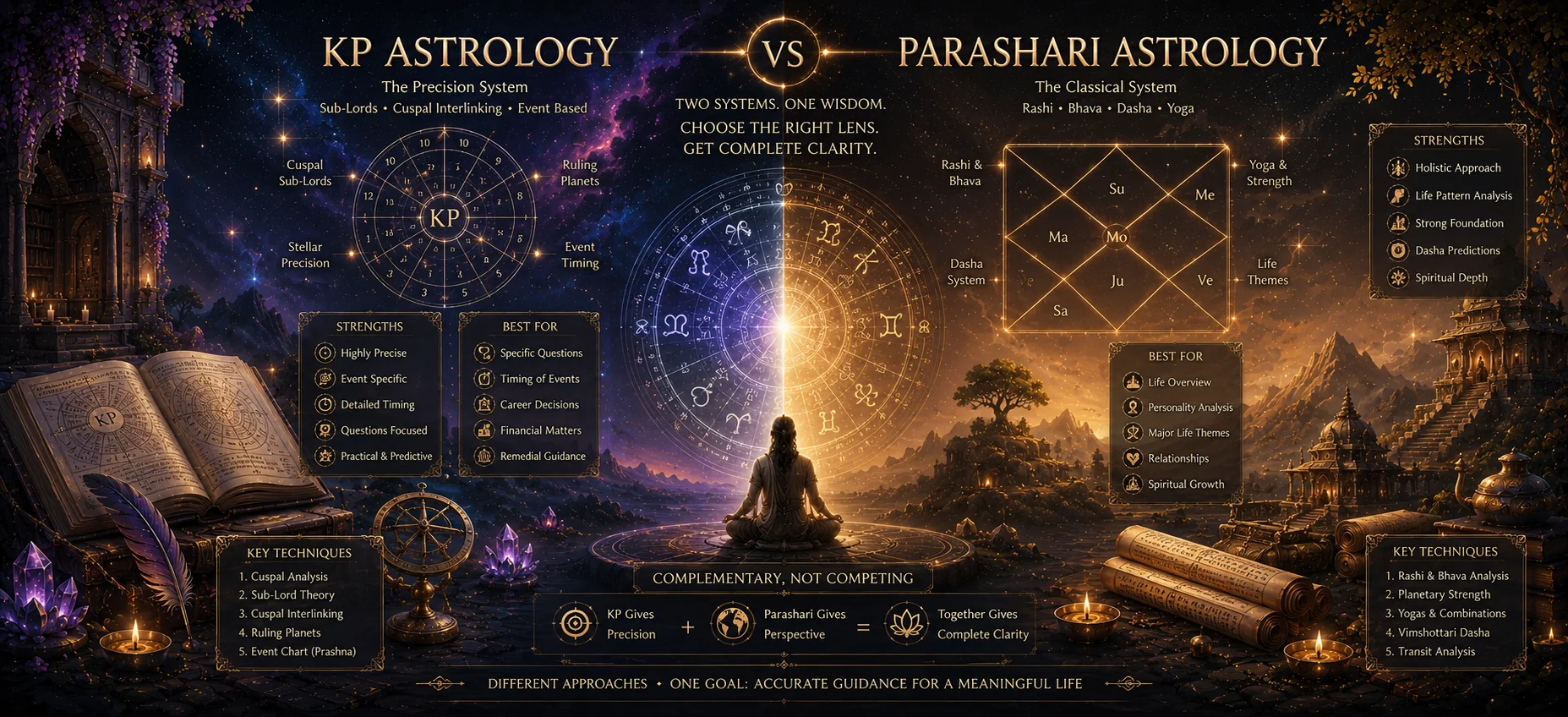
KP astrology vs Parashari is a question that arises often because both systems exist within the broader Vedic tradition but use different methodologies. Understanding the difference helps clients choose the right consultation approach for their question and helps Jyotishis use the right tool for the right job. This guide explains both systems, their relative strengths, and how they can be used together for maximum accuracy.
What is Parashari Jyotish?
Parashari Jyotish is the main classical tradition of Vedic astrology, derived from the Brihat Parashara Hora Shastra (BPHS) attributed to Sage Parashara. It is the foundation of most Indian astrological practice for the last two millennia.
The Parashari system uses:
- Whole-sign house divisions (each rashi is one house)
- The Vimshottari dasha system for timing
- Classical planetary aspects (drishtis)
- The 12 houses (bhavas) for life themes
- Divisional charts (vargas) for refined analysis
- Yogas and combinations from classical texts
Parashari is comprehensive: it covers personality, life themes, karmic patterns, dharma, and prediction. It is the framework most Indian astrologers learn first and apply most broadly.
What is KP Astrology?
KP astrology (Krishnamurti Paddhati) was developed by Prof. K.S. Krishnamurti between 1944 and 1972. KP refines the classical Vedic system with several methodological innovations:
- Cusp-based house divisions (Placidus or KP house system) rather than whole-sign
- The sub-lord theory: each nakshatra is divided into 9 unequal sub-divisions called subs, each ruled by a planet
- Stellar (nakshatra) ruler system for event analysis
- Specific KP rules for question (horary) astrology
- Emphasis on yes-or-no event prediction
KP is sometimes described as more "scientific" because of its mathematical precision and rule-based approach. The system was deliberately designed to remove ambiguity from prediction.
Key Methodological Differences
House Divisions
Parashari uses whole-sign houses: each rashi from the ascendant becomes the next house. If your lagna is Taurus, your 1st house is Taurus (entire sign), 2nd house is Gemini (entire sign), and so on.
KP uses cusp-based houses where the actual cusp degrees determine house boundaries. This means the 1st house may not coincide exactly with the lagna sign; it may extend into the next sign or end before the lagna sign ends.
Timing Systems
Parashari relies primarily on Vimshottari dasha for timing. Each native is in a specific Mahadasha and Antardasha at any given moment, and life events are predicted by these periods.
KP uses Vimshottari dasha but adds the sub-lord layer. The sub-lord of the relevant cusp (e.g., the 7th cusp for marriage) is the key indicator of whether and when an event happens. This adds substantial precision to timing.
Aspect Theory
Parashari uses planetary aspects (drishtis): each planet aspects specific other houses (Saturn aspects 3rd, 7th, 10th from itself; Mars aspects 4th, 7th, 8th; etc.). These aspects modify house themes.
KP places less emphasis on planetary aspects and more on stellar significators and sub-lord positions. The aspect framework is used but not central.
When to Use Parashari vs KP
Use Parashari for:
- Comprehensive life analysis
- Personality and karmic patterns
- Dharma and life purpose
- Long-term planning
- Spiritual guidance and remedies
- Understanding the full picture of a chart
Use KP for:
- Precise event timing (which month or year will it happen)
- Yes-or-no questions (will I get this job? will the deal close?)
- Horary (question) astrology
- Marriage compatibility timing
- Career timing precision
- When precision matters more than depth
In practice, both are used. A consultation might use Parashari to determine that the native is in a window of career change (the Mahadasha and main yogas support this) and KP to determine that the change will happen in a specific month based on sub-lord activation.
A Real Example
A client asked: "Will I marry this person within 18 months?"
The Parashari analysis showed:
- Venus Mahadasha, Mercury Antardasha active during the questioned window
- 7th house Venus is the karaka for marriage; well-supported by Jupiter aspect
- Navamsha shows Venus in compatible placement
- Conclusion: high probability of marriage during the window
The KP analysis added:
- The 7th cusp sub-lord is Mars
- Mars is the sub-lord of Venus's nakshatra and is favorable for marriage events
- The active KP timing shows marriage indicators converging in months 4-7 of the 18-month window
- Conclusion: marriage most likely within months 4-7
The Parashari prediction (within 18 months) was correct. The KP refinement (within months 4-7) narrowed it to a specific window. Both were useful; the combination was more useful than either alone.
Which System Should You Choose for Consultation?
The honest answer is: ask your Jyotishi which system they are trained in and use. At Soul Infinity, both Parashari and KP are used together. The choice of emphasis depends on your question:
- If you want to understand your whole chart, your dharma, your life themes, and your karmic patterns: Parashari-led consultation
- If you have a specific question with a specific time horizon (will I marry, will I get this job, will the deal close): KP-led consultation
- If you want comprehensive analysis with high timing precision: integrated Parashari-KP consultation
The Honest Verdict
Neither system is "more accurate" in an absolute sense. Both are powerful when used by trained practitioners. The accuracy depends on:
- Training and experience of the Jyotishi
- Precision of birth data
- Whether the question matches the system's strength
- Whether convergent indicators (multiple tools showing the same conclusion) are present
Avoid astrologers who insist their system is the only valid one. The classical traditions have always integrated multiple approaches, and the best modern Jyotishis do the same.
Booking a Consultation
For a consultation that integrates Parashari and KP astrology with BNN where appropriate, contact Soul Infinity through WhatsApp. Specify the kind of question you want addressed (comprehensive analysis, timing precision, or specific event), and we will recommend the right consultation approach.