
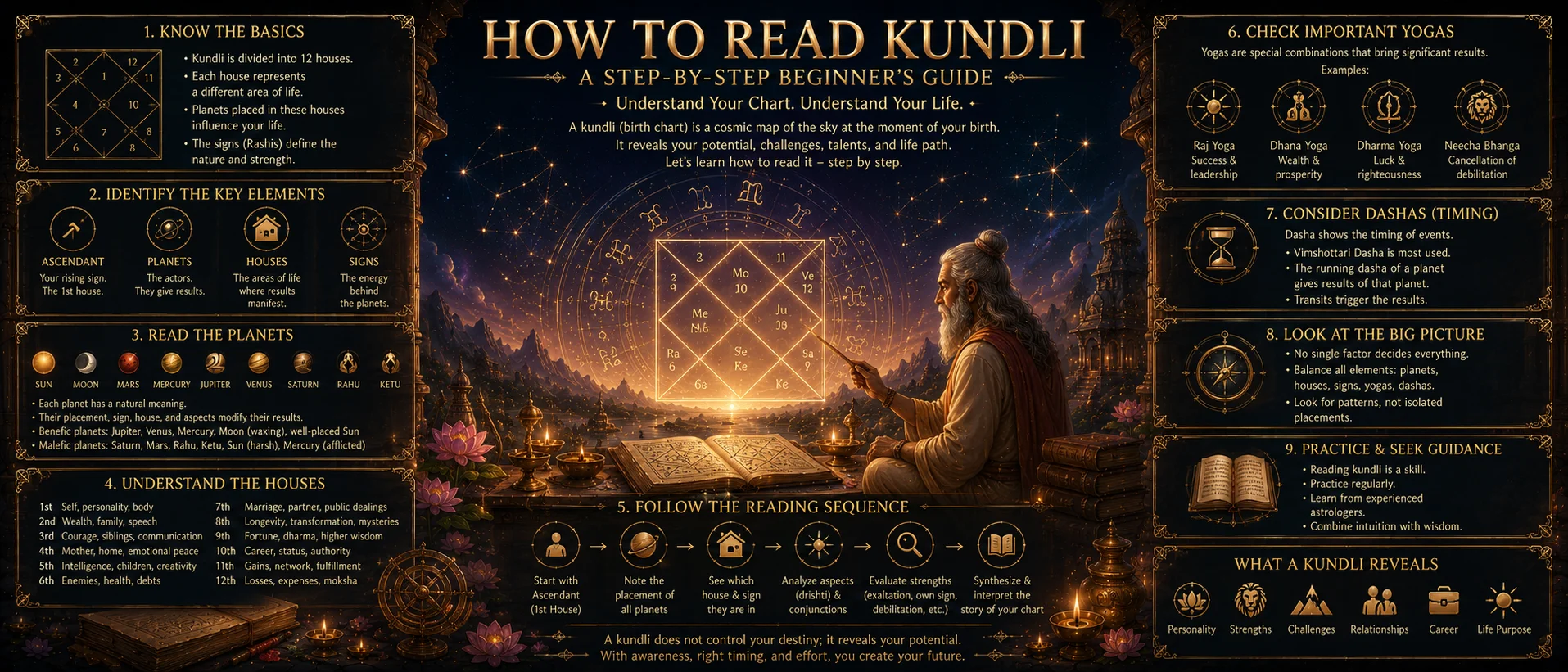
How to read kundli is one of the most common questions for anyone beginning to explore Vedic astrology. This guide provides a step-by-step beginner's framework for reading your birth chart: understanding the structure, identifying the key elements, and learning to interpret what the chart reveals. The goal is orientation, not full mastery; accurate prediction requires trained study and consultation.
What is a Kundli?
A kundli (also called janam kundli, janam patrika, or birth chart) is a graphic representation of the sky at the exact moment of your birth, as seen from your birth place. It shows the positions of the planets, the rising sign (ascendant), and the 12 houses that form the structural framework for analysis.
In Vedic tradition, the kundli is the foundation of all astrological work: personality analysis, life prediction, marriage compatibility, career guidance, and spiritual orientation.
Information Needed to Generate a Kundli
To generate an accurate kundli, three pieces of information are essential:
- Exact date of birth (day, month, year)
- Exact time of birth (hour, minute, ideally to the minute)
- Exact place of birth (city and country, sometimes precise to the locality)
The time of birth is the most important and the least often known precisely. Even small variations in time can shift the ascendant by significant degrees, which affects the entire chart structure. When time is uncertain, birth-time rectification techniques can refine the time using known life events.
North Indian vs South Indian Kundli Style
Two common kundli formats:
North Indian (Hexagonal/Diamond): The chart is drawn as a square with diamond and triangle subdivisions. The ascendant is always at the top center. Houses are read counterclockwise.
South Indian (Square Grid): The chart is drawn as a 4x4 grid with 12 outer cells and 4 inner cells. The ascendant moves to wherever it falls in the zodiac; the signs are fixed in position with Pisces at the top left and Aries at the top center-left.
Both formats contain the same information. The differences are visual only.
The 12 Houses (Bhavas)
The 12 houses are the structural foundation of the kundli. Each house governs specific life areas:
- 1st House (Lagna Bhava): Self, body, personality, life direction
- 2nd House (Dhana Bhava): Wealth, family, speech, accumulated resources
- 3rd House (Parakrama Bhava): Courage, siblings, short journeys, communication
- 4th House (Sukha Bhava): Home, mother, vehicles, emotional comfort, education
- 5th House (Putra Bhava): Children, creativity, romance, intelligence, past life merits
- 6th House (Ari Bhava): Enemies, service, illness, debts, daily routine
- 7th House (Kalatra Bhava): Marriage, partnership, public dealings
- 8th House (Ayur Bhava): Transformation, inheritance, longevity, occult, hidden matters
- 9th House (Dharma Bhava): Dharma, father, teacher, higher learning, pilgrimage
- 10th House (Karma Bhava): Career, public role, reputation, authority
- 11th House (Labha Bhava): Gains, networks, elder siblings, fulfillment of desires
- 12th House (Vyaya Bhava): Loss, expenses, foreign matters, moksha, isolation
The first thing to identify in any kundli is which planet sits in which house.
The 12 Signs
The 12 zodiac signs each have specific characteristics:
| Sign | Element | Quality | Lord | |---|---|---|---| | Aries (Mesha) | Fire | Movable | Mars | | Taurus (Vrishabha) | Earth | Fixed | Venus | | Gemini (Mithuna) | Air | Dual | Mercury | | Cancer (Karka) | Water | Movable | Moon | | Leo (Simha) | Fire | Fixed | Sun | | Virgo (Kanya) | Earth | Dual | Mercury | | Libra (Tula) | Air | Movable | Venus | | Scorpio (Vrishchika) | Water | Fixed | Mars | | Sagittarius (Dhanu) | Fire | Dual | Jupiter | | Capricorn (Makara) | Earth | Movable | Saturn | | Aquarius (Kumbha) | Air | Fixed | Saturn | | Pisces (Meena) | Water | Dual | Jupiter |
Each sign's element, quality, and lord shape how planets behave when placed there.
The 9 Planets (Grahas)
Vedic astrology uses nine planets:
- Sun (Surya): Soul, authority, father, vitality, ego
- Moon (Chandra): Mind, emotions, mother, public popularity
- Mars (Mangala): Energy, courage, brothers, real estate
- Mercury (Budh): Intellect, communication, business, education
- Jupiter (Brihaspati): Wisdom, dharma, husband (in female chart), children
- Venus (Shukra): Beauty, marriage, wife (in male chart), comforts
- Saturn (Shani): Discipline, profession, longevity, karma
- Rahu (North Node): Ambition, foreign matters, illusion
- Ketu (South Node): Detachment, spirituality, past life
The position of each planet (which sign, which house, with which other planets) shapes how it expresses in the native's life.
Step-by-Step Kundli Reading for Beginners
Step 1: Identify the Ascendant
Find your lagna (rising sign). This is shown by the number 1 in the ascendant house. Identify which sign is rising. The ascendant lord (the planet ruling the ascendant sign) is one of the most important planets in your chart.
Step 2: Locate the Moon
Find which sign and house the Moon occupies. Your Moon sign determines your "rashi" in popular Vedic usage. The Moon is the most important planet for emotional and mental themes.
Step 3: Locate the Sun
Find which house the Sun occupies. The Sun's house indicates where the native seeks authority, recognition, and self-expression.
Step 4: Identify Planets in Kendras (1, 4, 7, 10)
Planets in kendras (angular houses) are particularly powerful. They shape the major themes of life. Note which planets, if any, occupy these houses.
Step 5: Identify Planets in Trikonas (1, 5, 9)
Trikona (trine) houses are also powerful, particularly for benefic results. Note planets here.
Step 6: Check Planet Dignity
For each planet, check whether it is in its own sign, exaltation, debilitation, friendly sign, or enemy sign. Own sign and exaltation strengthen the planet; debilitation weakens it.
Step 7: Read the 7th and 10th Houses
For most people, marriage and career are the practical areas of greatest concern. Look at:
- Which sign is on the 7th cusp
- Which planets, if any, occupy the 7th house
- Where the 7th lord is placed
- Similarly for the 10th house
Step 8: Identify Major Yogas
Yogas are planetary combinations that produce specific results. Some major yogas to look for:
- Raj Yoga: Combination of a kendra lord and a trikona lord (brings success)
- Dhana Yoga: Combinations involving the 2nd, 5th, 9th, 11th houses (brings wealth)
- Pancha Mahapurusha Yoga: A planet (Mars, Mercury, Jupiter, Venus, or Saturn) in own sign or exaltation in a kendra (brings excellence in that planet's themes)
- Vipareeta Raja Yoga: Reversal of difficulty into strength
A trained Jyotishi can identify which yogas are active and how they affect life outcomes.
Step 9: Note Active Dasha
The Vimshottari Mahadasha and Antardasha currently active determine which themes are most prominent in your current life period. The major Vedic astrology software programs calculate this automatically.
Step 10: Consult a Trained Jyotishi
After self-orientation, consult a trained practitioner for the deeper layers: divisional charts (D9 navamsha, D10 dashamsha, others), ashtakavarga, sub-lord analysis, and integration of all elements into actionable guidance.
Common Mistakes Beginners Make
Reading only Sun sign: Vedic astrology uses Moon and ascendant much more than Sun for personality and prediction.
Ignoring the ascendant: The ascendant determines the entire house structure. Two natives with the same Moon sign but different ascendants have very different charts.
Mistaking Western for Vedic: Western Sun signs and Vedic Sun signs often differ by one. The sidereal versus tropical zodiac matters.
Focusing only on planets, ignoring houses: The same planet in different houses produces very different results.
Trying to read without dasha context: The same chart manifests differently in different dasha periods.
What to Expect in a Professional Reading
A professional Vedic consultation at Soul Infinity covers:
- Complete chart casting with North Indian and South Indian formats
- Ascendant and Moon analysis
- Planetary dignity assessment
- Major yogas identification
- Divisional chart analysis (D9, D10, others as relevant to your questions)
- Active dasha and antardasha analysis
- Current transit influences
- Practical guidance for upcoming life themes
- Remedies tailored to your chart
Booking a Consultation
For a Vedic kundli reading that goes beyond beginner orientation into actionable life guidance, contact Soul Infinity through WhatsApp.